
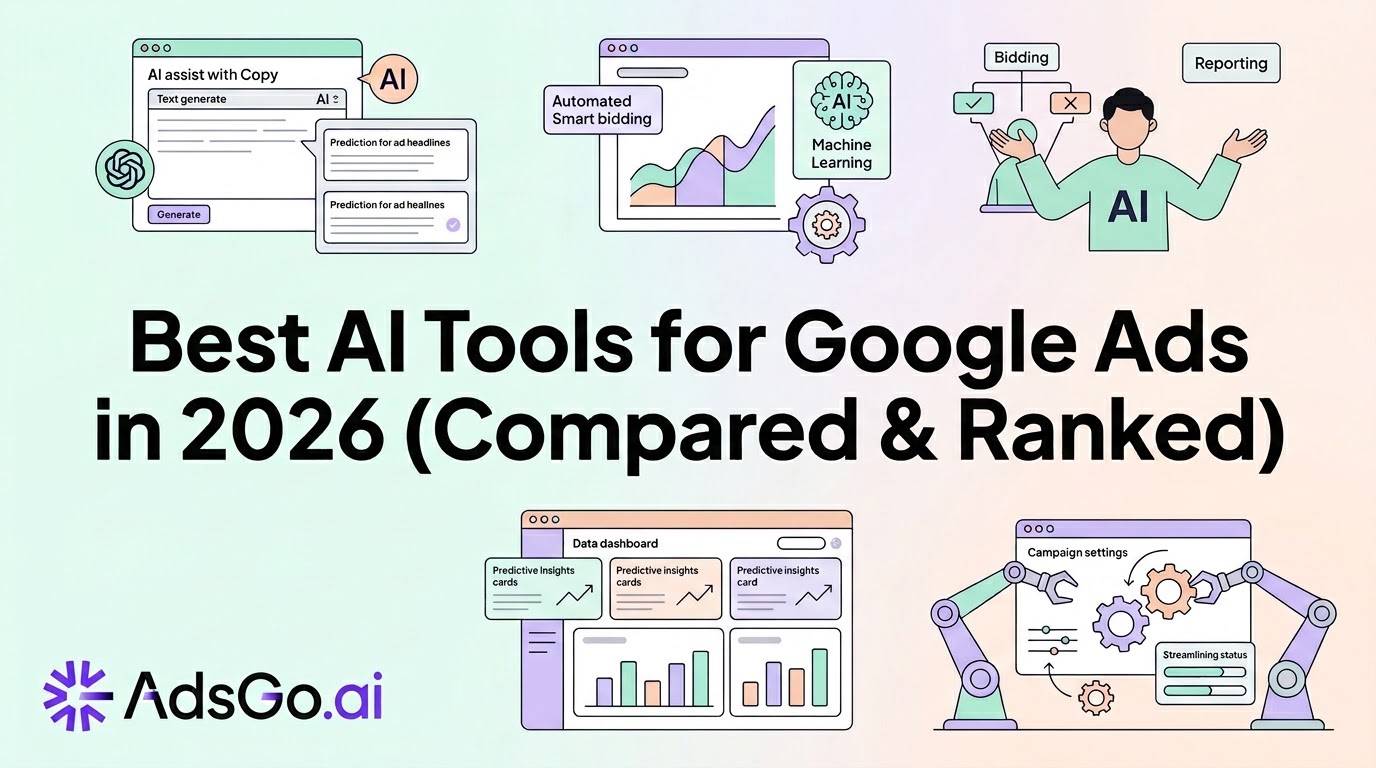
The best AI tools for Google Ads in 2026 are not interchangeable — and "AI" is one of the most overloaded labels in PPC software. One product optimizes RSAs, another proposes negatives, a third generates images, and a fourth promises to "do everything." Meanwhile Google Ads itself got heavier: Performance Max, value rules, offline conversions, Merchant Center feeds. The real work is architecture and measurement — not a clever headline.
This guide separates what each tool actually does, who it's for, and when it will not help you.
What are AI tools for Google Ads?
AI tools for Google Ads are third-party software products that use machine learning, automation, or generative AI to augment or replace manual tasks inside a Google Ads account. The category covers four distinct jobs — and most tools only do one of them well:
| Job | What the tool does | Example tools |
|---|---|---|
| CPA optimization | Surfaces hygiene fixes, negative gaps, bid recommendations | Opteo, Adzooma |
| Creative AI | Generates ad copy, images, video scripts, RSA variants | AdCreative.ai |
| Cross-channel systems | Connects Google + Meta budget and performance in one view | AdsGo, Madgicx |
| Enterprise governance | Multi-market program management, approvals, catalog ops | Skai, Smartly.io |
The critical distinction: these tools sit on top of Google's own AI (Smart Bidding, Performance Max). They do not replace it — they augment what Smart Bidding can't see (cross-channel context, creative supply, hygiene gaps) or reduce the manual work around it.
Too many Google Ads tools, still no unified view?
Why advertisers need AI tools in 2026
Google Ads in 2026 is harder to manage manually than it was in 2020 — for three structural reasons:
1. Automation requires more feeding, not less Performance Max and Smart Bidding make campaign decisions automatically — but they depend on high-quality inputs: feed data, conversion signals, creative assets, and value rules. Getting those inputs right is now a bigger job than writing individual ads.
2. Cross-channel complexity exploded Most advertisers now run Google and Meta simultaneously. Each platform reports its own ROAS as "the truth." Without a cross-channel view, budget allocation decisions happen in spreadsheets after two exports — costing hours and introducing errors.
3. Signal loss changed what's measurable iOS privacy changes, cookieless attribution, and modeled conversions made native platform reporting less reliable. AI tools that help with signal recovery (CAPI, enhanced conversions, offline imports) or that give a blended view across platforms are increasingly necessary to make budget decisions confidently.
When native Google tools aren't enough:
- You run Google + Meta and need one P&L view
- Smart Bidding is live but ROAS still doesn't reflect true margin
- Creative throughput (not bids) is the performance bottleneck
- Your team spends more time reconciling dashboards than making decisions
Where advertisers actually fail (and why tools don't fix it)
Most teams don't struggle with Google Ads because campaigns are "bad." They struggle because:
- Budgets are split across Google and Meta with no unified decision system
- Reporting lives in different dashboards — Google shows profitable, Meta shows profitable, blended CPA still rises
- No one owns the question: which channel earns the next dollar?
At this point, adding another "AI tool for Google Ads" doesn't solve the problem. You're treating symptoms while the portfolio stays blind.
The deeper failure pattern:
- Google shows profitable campaigns
- Meta shows profitable campaigns
- Combined CPA keeps rising anyway
Why? Because no system decides where the next dollar should go. This is not a campaign problem — it is a system problem.
Tools don't fix performance. They expose where your system is broken.
If your conversion tracking is wrong, AI will optimize the wrong thing — faster. That's why the most important step before buying any AI tool is fixing measurement: pixel, conversion actions, value rules, and Merchant Center feed accuracy.
Best AI tools for Google Ads (2026 overview)
Seven tools cover the practical range for most advertisers — from SMB hygiene fixes to enterprise creative ops. Here's the short-answer summary before the full breakdown:
- Opteo — best for daily Google Ads hygiene and recommendation queues
- Adzooma — best for SMBs that want fewer missed basics with a gentle learning curve
- AdCreative.ai — best for creative throughput and RSA/PMax asset generation
- AdsGo — best for Google + Meta cross-channel budget and creative systems
- Madgicx — best for Meta-primary teams with Google as a secondary channel
- Skai — best for enterprise portfolio governance across markets
- Smartly.io — best for retail-scale creative operations and feed orchestration
The short answer: match tool to bottleneck. Hygiene gaps → Opteo or Adzooma. Creative throughput → AdCreative.ai. Google + Meta as one P&L → AdsGo. Enterprise governance → Skai or Smartly.io.
AI tools comparison table
| Tool | Best for | Key strength | Starting price |
|---|---|---|---|
| Opteo | Account hygiene & daily fixes | Continuous recommendation queue | ~$99/mo |
| Adzooma | SMB simplicity | Fewer missed basics, gentle learning curve | Free tier |
| AdCreative.ai | Creative volume & variants | Fast AI-generated asset throughput | ~$21/mo |
| AdsGo | Google + Meta cross-channel | AI budget allocation + creative systems | Free starter |
| Madgicx | Meta-primary + Google | Dense Meta tooling with Google modules | ~$49/mo |
| Skai | Enterprise governance | Multi-market program management | Custom |
| Smartly.io | Retail creative ops at scale | Feed + creative orchestration | Custom |
AI tools by use case
CPA optimization tools
These tools focus on Google account recommendations, alerts, and steady queues of fixes — not generative creative. They're most effective when Smart Bidding already runs on trustworthy conversions; the AI prioritizes hygiene and opportunity capture, not replacing Google's auction ML.
Opteo
Best for: Google Ads hygiene and daily optimization fixes
Pros:
- Continuous recommendation queue (keywords, bids, negatives as actionable cards)
- Pairs cleanly with Smart Bidding — adds hygiene without fighting automation
- Good for accounts where small misses compound over time
Cons:
- Not built for Google + Meta cross-channel orchestration
- If Meta spend changes your blended CPA, Opteo won't surface that context
Pricing: ~$99/month; varies by ad spend tier
Fit: Account managers who want guided daily priorities rather than custom scripts
Adzooma
Best for: SMBs that want fewer missed basics with a gentle learning curve
Pros:
- Lighter-touch optimization suggestions accessible to non-technical users
- Free tier available — low barrier to test
- Good for operational consistency across lean teams
Cons:
- May feel lightweight for sophisticated operators who live in scripts and BI
- Validate PMax-specific workflow coverage before relying on it for PMax-heavy accounts
Pricing: Free tier available; paid plans vary
Fit: Moderate-complexity accounts where adoption consistency matters more than maximal toggles
Creative AI tools
AdCreative.ai
Best for: Advertisers where creative throughput — not bids — limits scale
Pros:
- Rapidly generates creative variants for RSAs, display, and Performance Max asset groups
- Reduces time-per-variation vs manual design
- Useful when you need distinct angles to exit audience overlap
Cons:
- Policy and brand review still mandatory — AI speed is not compliance
- Not a bid or budget tool; pair with Smart Bidding or a separate optimization layer
Pricing: From ~$21/month
Fit: Teams where creative supply is the bottleneck and conversion tracking is already trustworthy
Cross-channel optimization tools
These products assume Google is not your only paid channel — or that finance already asks how Meta spend interacts with Search and Shopping.
AdsGo
Best for: Teams running Google and Meta as one P&L who need cross-channel budget and creative discipline
Pros:
- AI-assisted budget allocation across Google and Meta — not siloed per platform
- Structured launch workflows reduce setup drift across campaigns, regions, teammates
- Creative generation and copy assistance reduces tool sprawl
- Free starter plan available
Cons:
- If you only run Google and will never add Meta, a pure Google-focused hygiene tool may feel simpler in month one
- Requires a governance owner — any stack fails without someone approving changes
Pricing: Free starter plan; see pricing
Fit: Teams that run or will soon run Google + Meta as one acquisition system with fewer weekly reconciliation loops
Use AI Optimization for cross-campaign budget governance; use Ads Launcher when repeated setups drift across teammates or regions.
Madgicx
Best for: Meta-primary teams that still need Google touchpoints
Madgicx is known for dense Meta-first tooling; some teams also run Google-oriented modules. Culture skews Meta-primary with Google secondary — validate modules and regions on the vendor's site before assuming Google parity with a Google-native specialist.
If madgicx pricing or switching stacks is on the table before you lock a Google-secondary workflow, read 5 best Madgicx alternatives in 2026 for ranked picks and vendor pricing pages.
Fit: Meta-heavy growth teams, not Google-only operators who want the lightest possible stack.
Enterprise marketing suites
Skai (formerly Kenshoo)
Best for: Portfolio-style media operations with governance and multi-market complexity
Skai targets enterprise programs where approvals, audit trails, and multi-market rollups matter as much as marginal CPA. Implementation and TCO reflect enterprise expectations.
Fit: Large programs where media ops and approvals dominate — not single-account managers who need faster RSA drafts.
Smartly.io
Best for: Enterprise-scale retail creative ops and feed orchestration
Smartly.io focuses on catalog complexity and multichannel creative operations. For Google-centric readers, value shows when feed orchestration and creative ops are the constraint — not when a mid-market Search + Shopping account only needs cleaner RSAs.
Fit: Retail and creative ops at scale; validate Google module depth for your regions.
Running Google and Meta from separate dashboards with no unified view? AdsGo connects both channels in one workspace — AI optimization, budget allocation, and creative systems included. Starter plan free. → Try AdsGo free
Which AI tool should you use?
Use this decision framework to find the right tool in under 2 minutes:
If your problem is CPA — use Opteo or Adzooma If your problem is creative output — use AdCreative.ai If your problem is Google + Meta reporting fragmentation — use AdsGo If your problem is Meta-primary with some Google — use Madgicx If your problem is enterprise governance — use Skai If your problem is retail feed + creative at scale — use Smartly.io If your problem is broken measurement — fix tracking first, then buy tools
Full decision table:
| Bottleneck | Start here | Why |
|---|---|---|
| Missed basics, daily hygiene, recommendation queue | Opteo or Adzooma | Google-first optimization layers that pair with Smart Bidding |
| Asset throughput and variant volume | AdCreative.ai (+ native Smart Bidding) | Creative AI before stacking more bid tools |
| Google + Meta context switching | AdsGo | Cross-channel systems reduce duplicate audits |
| Meta-primary growth with Google as a line item | Madgicx (validate Google modules) | Dense Meta tooling culture |
| Portfolio governance and multi-market complexity | Skai | Enterprise governance patterns |
| Catalog-heavy retail and creative ops at scale | Smartly.io | Feed + creative orchestration |
| Measurement is broken | Fix pixels, conversions, Merchant Center first | No tool fixes bad data |
Note: two "optimization brains" fighting is a common failure mode. If you pay for Opteo-class recommendations AND a cross-platform optimizer that both move budgets, you'll get conflicting changes and noisy CPA. Pick one primary optimization layer with a written split of responsibilities.
Tools to reduce Google Ads CPA (quick picks)
If CPA reduction is the primary goal, match the tool to the root cause first:
| CPA leak | Root cause | Best tool fix |
|---|---|---|
| Hygiene and missed basics | Negative gaps, duplicate themes, geo splits | Opteo or Adzooma |
| Creative fatigue | Same assets running too long, low diversity | AdCreative.ai |
| Budget misallocation across channels | Google + Meta with no P&L view | AdsGo |
| Broken conversion tracking | Smart Bidding optimizing wrong objective | Fix pixel/GA4 first, then any tool |
| PMax cannibalizing Shopping | Campaign structure overlap | Structural audit first |
Tools only reduce CPA after measurement is honest. Fix conversion tracking before adding AI layers.
For the full diagnostic path: how to lower Google Ads CPA with AI and how to automate Google Ads campaigns.
For ecommerce-specific CPA strategy: how to run Google Ads for ecommerce.
When NOT to use AI tools
This is the section most comparison articles skip — knowing when a tool won't help is as important as knowing where it wins.
Do not add AI tools when:
- Conversion tracking is unreliable — AI will optimize the wrong objective faster
- Smart Bidding has less than 30–50 conversions per month — not enough signal; tools add noise
- You have two optimization systems issuing conflicting budget rules — consolidate first
- The bottleneck is landing pages or offer quality — no creative AI fixes a broken checkout
- You need legal scrutiny on every claim — generative speed does not replace compliance review
- Your category demands granular query control that PMax removes — validate before full commitment
Tool-specific "do not use" cases:
- Opteo — do not use when you need Meta + Google orchestration as one narrative; it's Google-only
- Adzooma — do not use when your team needs SQL-heavy custom analysis; UX is intentionally lightweight
- AdCreative.ai — do not use when landing pages, offers, or measurement are broken (new assets scale the leak)
- AdsGo — do not use when you will never run Meta and want the leanest possible Google-only seat
- Madgicx — do not use when Google is the center of gravity and Meta is experimental
- Skai — do not use when account size and process maturity cannot carry enterprise implementation cost
- Smartly.io — do not use when your bottleneck is a single RSA or thin feed
FAQ
What are AI tools for Google Ads?
AI tools for Google Ads are third-party software products that use machine learning or generative AI to automate or augment manual PPC tasks — including bid recommendations, negative keyword suggestions, creative generation, and cross-channel budget allocation. They sit on top of Google's own automation (Smart Bidding, PMax) rather than replacing it.
What are the best AI tools for Google Ads for small business?
For most SMBs, the best starting point is the smallest tool set that fixes the real leak: Opteo or Adzooma when hygiene and missed basics inflate CPA; AdCreative.ai only when creative throughput is the bottleneck; AdsGo when Google and Meta already split your budget with no unified view.
Are Google Ads automation tools enough without third-party AI?
Often yes — Google's native automation (Smart Bidding, rules, scripts) is enough when conversion tracking is clean and creative supply is steady. Third-party AI earns its seat when reporting, creative volume, or cross-channel governance breaks before the auction does.
Which tools reduce Google Ads CPA most effectively?
Match tool to root cause: hygiene gaps → Opteo or Adzooma; creative fatigue → AdCreative.ai; channel fragmentation → AdsGo; broken tracking → fix measurement first. No tool reduces CPA when conversion data is unreliable.
Should I use a creative AI tool or a bid optimization tool first?
If Smart Bidding is running and conversions are clean, bid and budget layers usually move CPA faster. If CTR is high but conversion rate is weak, fix landing pages first. Creative AI (AdCreative.ai) earns its place when creative supply — not bids — is the scaling bottleneck.
What is the single best AI tool for Google Ads?
There is no universal answer — the right tool depends on your bottleneck. Use the decision framework above: identify whether your constraint is CPA hygiene, creative throughput, cross-channel reporting, or enterprise governance, then match accordingly.
Is AdsGo only for beginners?
No. AdsGo is for teams that want less context switching between Google and Meta once both channels matter — it's a cross-channel decision layer, not a beginner's simplification tool.
When should I NOT buy a Google Ads AI tool?
When conversion tracking is broken, when Smart Bidding has insufficient data (under 30–50 monthly conversions), when you already have two optimization systems issuing conflicting budget rules, or when the real bottleneck is landing page quality or offer-market fit. Fix those upstream issues first.
How do I compare AI tools for Google Ads fairly?
Test one tool on one account over 4–6 weeks with a clear success metric (CPA target or ROAS floor). Read official documentation for the specific features you need — especially PMax support if PMax is your primary campaign type. Reconcile weekly spend to finance before standardizing across accounts.