
Facebook Ads audience targeting just changed — quietly, but fundamentally.
If you opened Meta Ads Manager recently and noticed a new field called “Describe your audience,” you are not imagining things.
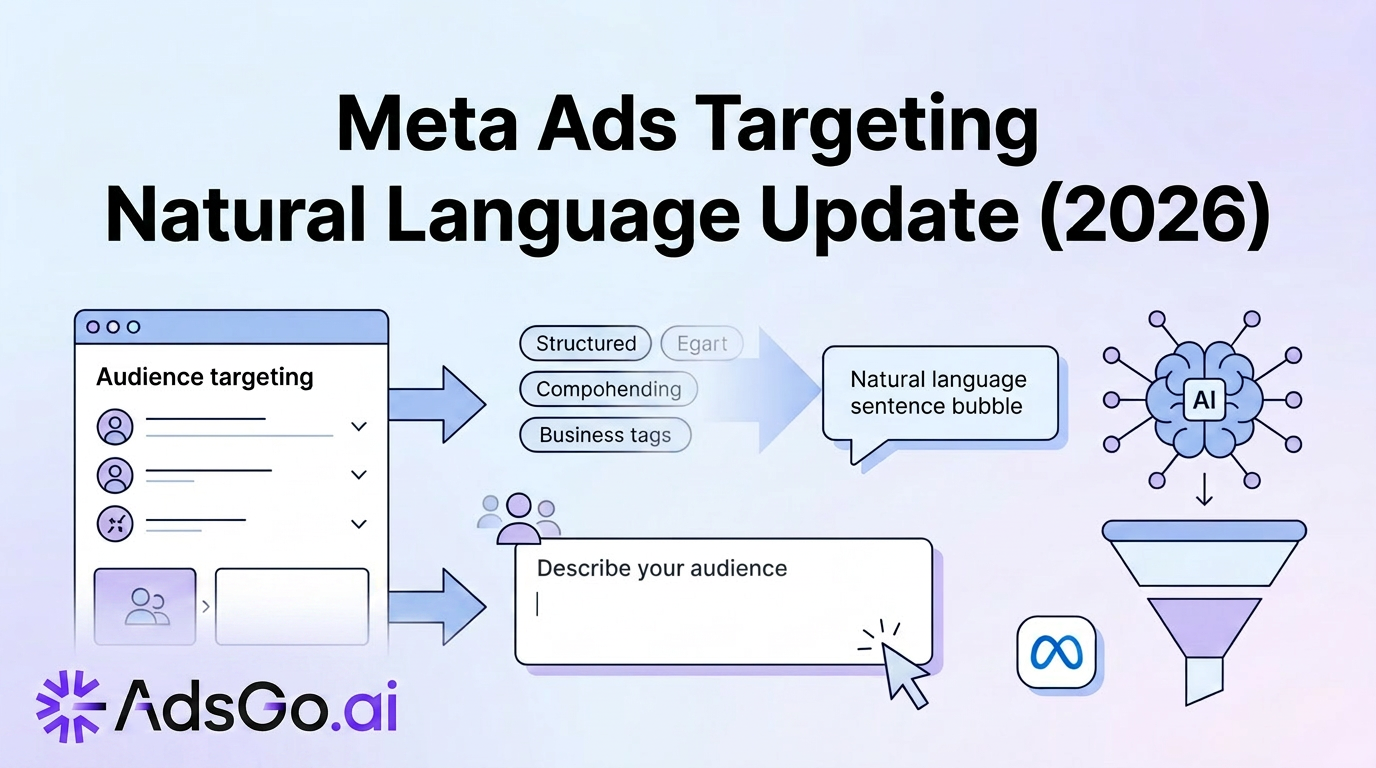
Facebook has officially started rolling out natural-language audience targeting inside Ads Manager.
At first glance, it looks like a UI upgrade.
But structurally, it is something much bigger: Meta is no longer asking advertisers to select audiences — it is asking them to describe intent.
What changed in targeting
Over the last few years, Meta has been removing layers of manual audience control:
- 2022: Advantage+ Shopping Campaigns → reduced audience control
- 2023: Advantage+ Audience → interest targeting becomes “suggestion-based”
- 2026: Natural-language audience input → no need to select structured interests
Now you can simply write:
RV owners looking for lightweight lithium batteries for off-grid camping and road trips
Instead of selecting:
- Interests: RV
- Interests: Camping
- Interests: Outdoor recreation
- Behaviors: Engaged shoppers
Meta’s system interprets intent directly.
Ready to Launch Smarter Campaigns?
Meta’s real strategy
This is not just a UX improvement. It is a systematic shift in control.
Before: advertisers controlled audience structure, segmentation logic, and testing design.
Now: advertisers control intent description only. Everything else — targeting, expansion, optimization, delivery — is handled by Meta’s algorithm.
Why Meta is doing this (the real incentives)
There are two layers to understand.
(1) Lower barrier to entry
Natural language removes the need to understand interest taxonomies, audience layering, or lookalike structures. Anyone can launch ads by describing “who they want to sell to.”
Result: more advertisers enter the system, more competition in auctions, higher CPM, higher Meta revenue.
(2) Gradual removal of optimization control
Each stage of Meta’s evolution reduces advertiser precision:
| Era | Control level |
|---|---|
| Interest targeting | High control |
| Advantage+ Audience | Partial control |
| Natural-language input | Semantic control only |
You are no longer optimizing “who sees ads.” You are optimizing how you describe intent.
What this means for advertisers in 2026
Short term: nothing breaks.
Long term: audience targeting stops being a core skill in the old sense. The value of an advertiser is shifting toward:
- Creative strategy — hooks, messaging angles, conversion psychology
- Data interpretation — when to scale, when to stop, what signal is real
- Audience expression quality (new) — the ability to translate customers into precise language
Bad: “people interested in camping.”
Good: “RV owners frustrated with heavy lead-acid batteries who want a lightweight lithium upgrade for extended off-grid travel.”
This is no longer targeting alone. It is intent engineering.
How to test this new feature (operator framework)
Instead of reacting emotionally, treat this as an experiment.
Campaign structure test: create three ad sets under the same campaign.
- Ad Set A — natural-language audience: use the “Describe audience” field; write a detailed intent-based description with context, pain points, and usage scenario.
- Ad Set B — traditional interest targeting: use your best-performing interest stacks (your control group).
- Ad Set C — broad targeting: no audience constraints; let Meta fully optimize.
Keep everything else identical: same creatives, same budget, same bid strategy.
Evaluate after 5–7 days. Track:
- CPA — cost efficiency
- CTR — message match
- CPM — audience competitiveness
The bigger shift
Meta is not just changing targeting. It is redefining how ads are built:
- Ads are no longer only configured — they are increasingly described.
- This shifts advertising from structural optimization → semantic optimization, from audience engineering → intent expression, from manual setup → algorithmic interpretation.
Why this matters for tools like AdsGo
As Meta reduces manual control, a new bottleneck appears: if everything is natural language, how do you ensure consistency across campaigns, channels, and budgets?
This is where the next layer of advertising systems emerges. Platforms like AdsGo are built around this shift: turning intent descriptions into structured execution, aligning Meta and Google under one strategy layer, reducing fragmentation between platforms, and connecting creative, budget, and optimization into one workflow.
Instead of manually rebuilding structures across platforms, teams can move toward describe once → execute everywhere. See Ads Manager for cross-platform visibility and Target Audience for audience workflows that stay coherent as inputs get more semantic.
Ready to use AI targeting on Meta? AdsGo's AI optimization works with Meta's latest targeting features automatically. → Try AdsGo free
Final takeaway
Meta is not giving advertisers more flexibility in the old sense — it is removing complexity. In return:
- Control becomes less granular
- Systems become more opaque
- Language becomes the new targeting skill
The question is no longer only “Which audience should I choose?” It becomes: How well can I describe my customer so the system understands them?
In that shift, the winners will not be those who know the most targeting tricks — but those who can translate customer intent into machine-readable strategy. If you are scaling on both Google and Meta, Ads Launcher can help keep launches consistent while you refine how you phrase intent in each channel.