
Your Advantage+ campaign hit 4.2x ROAS last Tuesday. By Friday it was at 1.6x — same creative, same budget, no settings changed. Meta's dashboard still shows a green delivery status.
That swing is not a bug in your account. It is how Advantage+ behaves in 2026: powerful when the algorithm has clean data and fresh creative, volatile when it does not. The platform automates delivery decisions Meta used to leave with media buyers — audience expansion, placement mix, budget pacing — but it does not automate the inputs those decisions depend on.
This Meta Advantage+ review cuts through the marketing pitch: what the performance data actually shows, why results cluster at extremes, and the 4 Control Gates every SMB advertiser should pass before treating Advantage+ as a set-and-forget channel.
People also search for this topic:
- is meta advantage plus worth it for small business
- advantage plus vs manual facebook ads
- why did my advantage plus roas drop
- advantage plus shopping vs sales campaigns
What Is Meta Advantage+?
Meta Advantage+ is Meta's AI-driven advertising suite that automates campaign delivery — audience selection, placement allocation, and creative optimization — within a single campaign workflow. Advantage+ Shopping Campaigns (ASC) target ecommerce catalogs; Advantage+ Sales campaigns cover broader conversion objectives with similar automation.
It is not one toggle. In 2026, "Advantage+" spans Advantage+ Audience (targeting suggestions, not hard limits), Advantage+ Placements, Advantage+ Creative enhancements, and full Advantage+ campaign types that bundle these together. Each layer removes manual control and delegates more decisions to Meta's machine learning models.
The trade-off is intentional: Meta gains auction efficiency by routing spend toward predicted converters; advertisers gain speed but lose transparency into who saw the ad, which placement drove the click, and whether reported ROAS reflects new customers or retargeted buyers.
If you are still building manual campaign structures, see best Meta ads structure in 2026 for how Advantage+ fits alongside prospecting and retargeting layers — not instead of them.
Advantage+ running but ROAS feels off?
Promise vs Reality Data
Meta and third-party analyses cite strong headline metrics for Advantage+ when conditions align.
| Claim | Reported result | Source context |
|---|---|---|
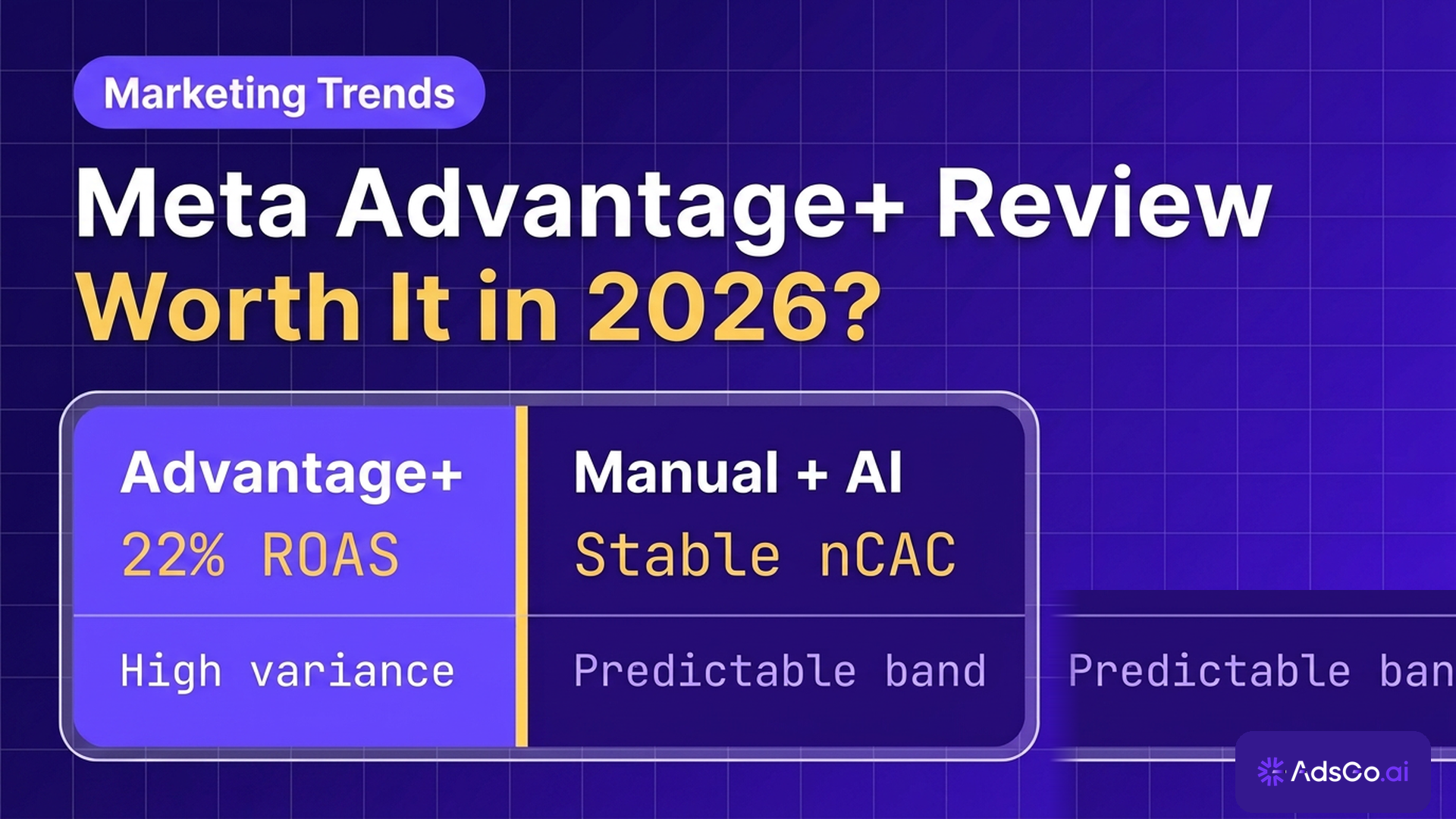
| ROAS lift vs manual | Up to ~22% higher | Aggregated advertiser analysis (Source: industry analyst reports cited in 2025–2026) |
| CPC reduction | Up to ~28% lower | Same comparative studies |
| Cost per conversion | ~7% lower | Platform efficiency gains under stable signal |
Those numbers are real for accounts that already have strong pixel/CAPI data, proven creative, and enough weekly conversion volume for the algorithm to learn. They are not guaranteed baselines for new accounts or thin catalogs.
The reality gap shows up in two trends advertisers report more often than Meta highlights:
| Trend | What advertisers see | Why it matters |
|---|---|---|
| Barbell performance | Campaigns either crush targets or miss badly — little stable middle | Budget feels random; hard to forecast |
| Rising nCAC | New customer acquisition cost climbing even when blended ROAS looks fine | Retargeting inflates ROAS while growth stalls |
Data from attribution platforms including Wicked Reports has documented nCAC more than doubling for some Advantage+ advertisers while blended ROAS stayed flat (Source: Wicked Reports industry analysis, 2025). Blended ROAS can hide the problem: existing customers convert cheaply, the algorithm finds them easily, and reported returns look healthy while new-customer economics deteriorate.
Track nCAC separately from blended ROAS. If only one metric moves, Advantage+ may be optimizing toward the easiest conversions — not the growth you need.
The Barbell Performance Pattern
Advantage+ results in 2026 often follow a barbell distribution: a small share of campaigns deliver outsized ROAS, a larger share underperform, and stable "moderate winners" are rare compared with manual structures.
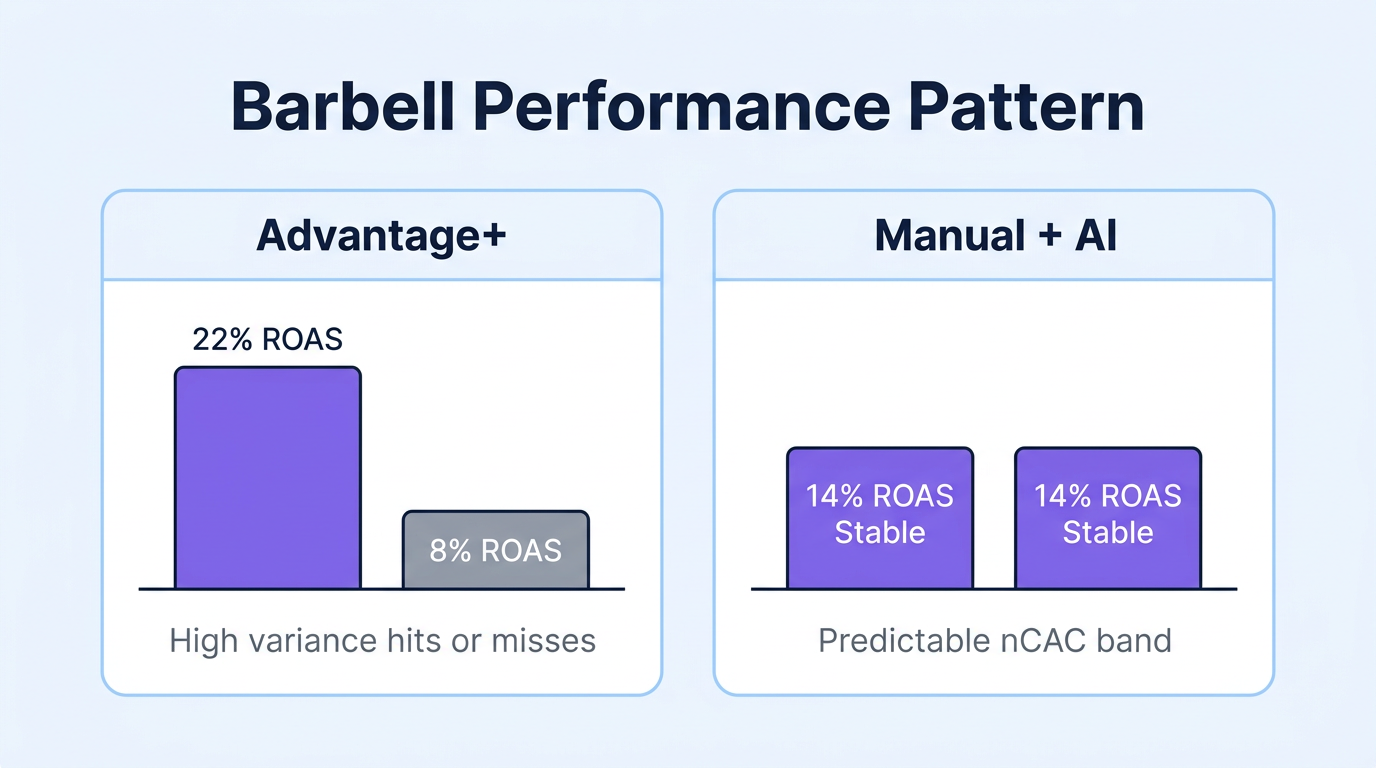
Three forces drive the barbell:
| Force | Mechanism | Advertiser symptom |
|---|---|---|
| Algorithm confidence | Meta spends aggressively when early signals look strong | Budget spikes before validation completes |
| Audience expansion | Advantage+ Audience treats inputs as suggestions | Reach drifts beyond intended segments |
| Creative concentration | System favors one winning ad | Frequency climbs; CTR drops within days |
The barbell is not a reason to avoid Advantage+. It is a reason not to scale Advantage+ budget until your measurement and creative pipeline can survive both ends of the curve.
Manual campaigns spread results more evenly because humans cap spend, rotate creative, and enforce audience boundaries. Advantage+ removes those guardrails by design — which is why external monitoring matters more, not less.
Four Control Gates Before Scaling
Random Advantage+ launches produce random barbell outcomes. The 4 Control Gates framework defines minimum readiness before you allocate more than test budget to full Advantage+ automation.
| Gate | Requirement | Pass signal |
|---|---|---|
| 1 — Signal | Pixel + CAPI with deduplication | 50+ weekly optimization events |
| 2 — Creative | 3+ fresh variants in rotation | No single ad above 40% of spend |
| 3 — Measurement | nCAC tracked separately from blended ROAS | nCAC stable within 15% over 14 days |
| 4 — Guardrails | Budget caps and kill rules documented | No unplanned 30%+ daily spend spikes |
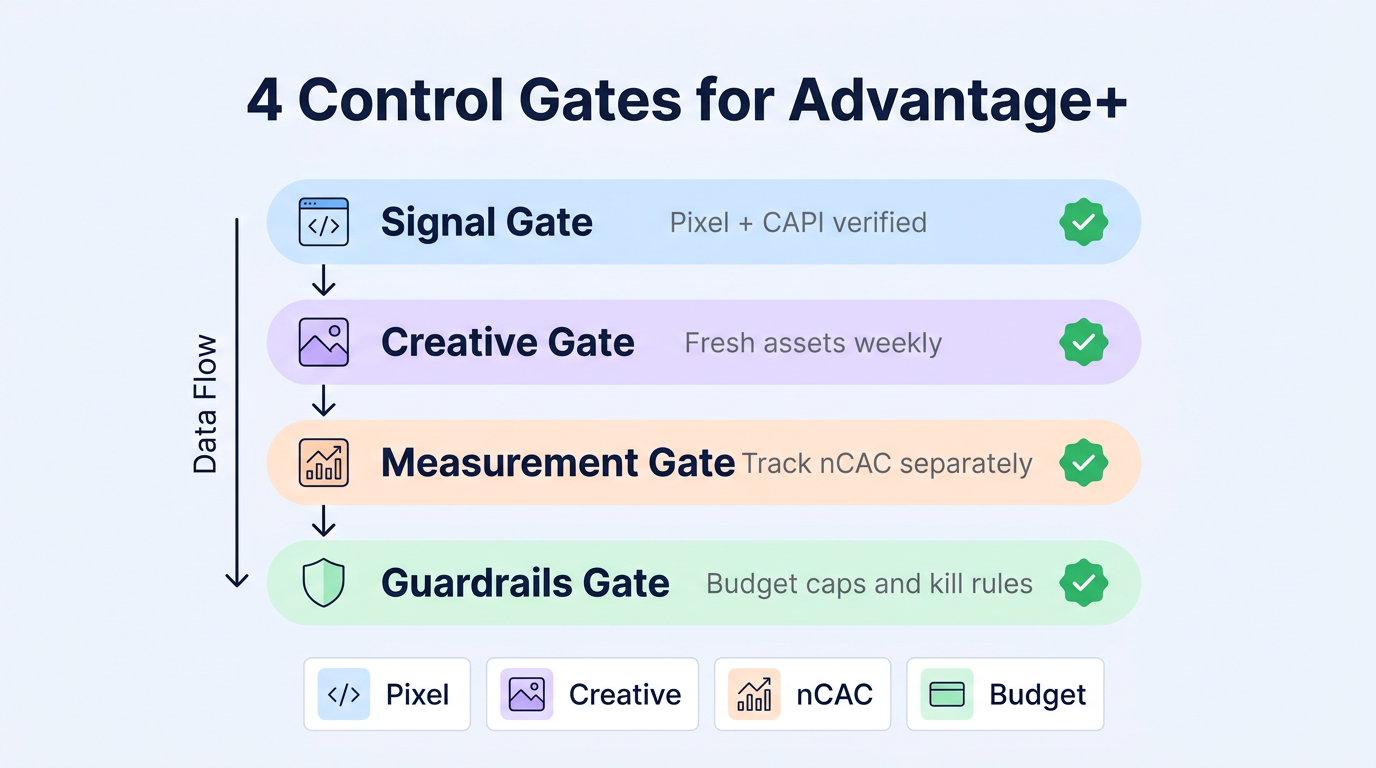
Gate 1 failing is the most common SMB mistake: launching Advantage+ Shopping on a pixel with broken Purchase tracking or under 20 weekly conversions. The algorithm has nothing reliable to learn from — so it guesses, spends, and produces barbell noise.
Gate 2 matters because Advantage+ accelerates creative fatigue. Accounts that upload one hero ad and enable ASC often see a strong week followed by a cliff. Pair Advantage+ with a weekly creative refresh cadence so the system always has alternatives to test.
Gate 3 separates real growth from retargeting inflation. If blended ROAS is 3.5x but nCAC rose 40% month-over-month, Advantage+ is working for retention, not acquisition.
Gate 4 keeps the barbell from breaking your cash flow. Set maximum daily budget increases (10–20% every 3–4 days), define CPA kill thresholds, and review placement breakdowns weekly even when Meta recommends "leave it alone."
Advantage+ Pros and Cons
| Pros | Cons |
|---|---|
| Faster setup than manual campaign stacks | Limited reporting by age, gender, placement |
| Can find converters manual targeting misses | Audience drift beyond specified segments |
| Strong scaling speed when creative supply is deep | Barbell outcomes — big wins or big losses |
| Lower CPC in many verticals vs restricted manual setups | Blended ROAS can mask rising nCAC |
| Improves as conversion volume grows | Retargets existing customers aggressively |
| Reduces daily audience micromanagement | Requires external tools to verify true performance |
Advantage+ earns its place in a modern Meta stack — usually as one layer (catalog ASC or a single Sales campaign), not the entire account. Most SMB accounts perform best with Advantage+ on 30–50% of prospecting budget while manual or hybrid campaigns hold audience tests and retargeting separation.
What SMB Advertisers Should Do
Use this decision tree before increasing Advantage+ spend:
| Your situation | Recommended move |
|---|---|
| Under 50 weekly conversions | Fix tracking first; run manual broad campaigns |
| 50–150 weekly conversions, stable nCAC | Test ASC at 20–30% of prospecting budget |
| 150+ conversions, 3+ fresh creatives weekly | Scale ASC to 40–50%; keep manual retargeting separate |
| ROAS up but nCAC rising | Cap existing-customer budget; add prospecting exclusions |
| Performance swing week to week | Pause scaling; pass Gate 3 and Gate 4 before adding budget |
Minimum practical test: 14 days, equal creative inputs vs your best manual campaign, compare nCAC and new-customer revenue — not blended ROAS alone.
For ecommerce brands, Advantage+ Shopping works best with a verified domain, prioritized AEM events, and Maximum data sharing enabled. For lead gen, Advantage+ Sales with a clear conversion event and CRM offline conversion import closes the loop Meta's dashboard cannot see.
Pair native automation with a verification layer. AI Optimization reallocates budget when CPA drifts; Ad Insight surfaces when reported conversions diverge from backend order data — the gap Advantage+ most often hides.
FAQ
Is Meta Advantage+ worth it in 2026?
Yes — for advertisers with clean conversion signals, enough weekly volume (typically 50+ optimization events), and a steady creative pipeline. It is not worth treating as hands-off automation without measurement guardrails. SMB accounts that fail Gate 1 or Gate 3 usually see barbell volatility, not stable ROAS.
What is the difference between Advantage+ Shopping and Advantage+ Sales?
Advantage+ Shopping (ASC) is built for ecommerce product catalogs — dynamic product ads, catalog sales optimization, and shopping-specific automation. Advantage+ Sales is the broader conversion objective for leads, apps, and non-catalog offers. Pick ASC if you sell physical products through a Meta-connected catalog; pick Sales for everything else.
Why does Advantage+ ignore my audience targeting?
Advantage+ Audience treats your targeting inputs as strong suggestions, not hard boundaries. Meta's model optimizes for predicted conversions across its full user base. If it finds cheaper converters outside your specified interests, it will reach them. That is by design — which is why nCAC tracking and periodic audience composition reviews matter.
Why did my Advantage+ ROAS drop suddenly?
Common causes: creative fatigue on a single winning ad, audience saturation, seasonal CPM increases, or the algorithm shifting spend toward retargeting pools. Check frequency, creative spend distribution, and nCAC before changing campaign settings. Often the fix is new creative (Gate 2), not a budget cut.
Do I need a third-party tool with Advantage+?
Not always. Accounts with strong in-house reporting and weekly creative refreshes can run Advantage+ natively. Third-party or AI layers earn their place when you need automated budget guardrails, cross-campaign attribution checks, or creative fatigue detection Meta's dashboard does not surface clearly.
How much budget does Advantage+ need?
Meta's guideline centers on conversion volume, not a fixed dollar amount. Aim for enough weekly spend to generate 50+ optimization events. At $25 cost per purchase, that implies roughly $1,250/week minimum — adjust for your actual CPA. Below that threshold, manual campaigns with tighter control usually learn faster.
How AI Verifies Advantage+
Advantage+ distributes spend efficiently inside Meta's auction. It does not tell you whether those conversions are new customers, whether creative fatigue started three days before ROAS fell, or whether pixel gaps are starving the algorithm of signal.
The sustainable workflow: use Advantage+ for delivery automation, use external monitoring for truth. Weekly nCAC checks, creative rotation schedules, and backend-to-Events-Manager reconciliation catch barbell drops before they consume a month's budget.
AdsGo sits in that verification layer — not replacing Meta's AI, but making its outputs auditable for SMB teams without a full-time analytics hire.
Test Advantage+ with the 4 Control Gates first. Scale only when signal, creative, measurement, and guardrails all pass. That is how you capture the 22% ROAS upside analysts report without riding the wrong side of the barbell.