

You have $1,000, $5,000, or $10,000 a month for paid media. The wrong split does not just waste clicks — it burns the learning phase on both platforms before either algorithm has enough data to optimize.
Facebook Ads vs Google Ads is not a branding debate. Google captures existing search demand. Meta creates demand with creative. At $1K/month those jobs cannot both get enough spend to exit learning. At $10K/month, running only one channel usually leaves demand on the table.
In this guide, you will get tier-specific splits, CPA benchmarks, a named decision framework, and the management-time cost competitors rarely price in — so you can choose a channel mix before you open Ads Manager.
Budget-Based Channel Choice
Facebook ads vs google ads is a budget allocation question, not a platform popularity contest. Google and facebook advertising split demand capture (search) from demand creation (feed). Your monthly ad spend decides whether you can run both channels with enough data to optimize, or must prove one platform before adding the second.
Google ads vs facebook ads and google ads vs meta ads ask the same thing: where does your next dollar earn the lowest cost per acquisition for how people discover your offer? Search intent sits at the bottom of the funnel; social discovery sits at the top — but thin splits at low budgets starve learning on both sides.
Quick answer: Under $3K/month, pick one primary channel. From $3K–$8K, run Meta for demand plus Google branded search. Above $8K–$10K, add Google non-brand or Shopping and Meta retargeting so each platform handles the funnel stage it wins.
Splitting budget across Meta and Google manually?
The Budget Channel Router (BCR)
The Budget Channel Router is a three-tier model for ad spend decision-making. Competitor comparisons list features and average CPC. BCR answers a different question: at your actual monthly budget, which channel mix reaches statistical significance fastest and which management tasks you can still execute in-house.
| BCR tier | Monthly spend | Primary job | Default split |
|---|---|---|---|
| Tier 1 — Prove | $1,000–$2,999 | Exit learning on one channel | 100% one platform |
| Tier 2 — Bridge | $3,000–$7,999 | Capture demand Meta creates | 60–70% Meta / 30–40% Google |
| Tier 3 — Compound | $8,000–$10,000+ | Full-funnel coverage | 45–55% Meta / 35–45% Google + retargeting |
Use BCR before you compare roas comparison screenshots from dashboards. Platform-reported ROAS overstates performance when conversion paths cross devices; treat tier moves as monthly reviews, not daily panic shifts.
Spend Tiers at a Glance
These benchmarks reflect blended SMB accounts in 2025–2026, not enterprise finance or legal auctions. Your cost per click comparison changes by industry, but the direction — Meta cheaper clicks, Google higher intent per click — holds across most categories.
| Metric | Google Ads (Search) | Facebook / Meta Ads |
|---|---|---|
| Typical CPC | $2.00–$3.50 | $0.80–$1.40 |
| Typical CPM | $30–$45 | $12–$18 |
| Cold traffic CVR (ecommerce) | 3.5–5.5% | 1.2–2.5% |
| Typical CPA (ecommerce) | $45–$75 | $22–$45 |
| Min. daily spend to learn | ~$50–$80/day | ~$30–$50/day |
| Weekly operator time @ $5K | 3–5 hours | 4–6 hours |
(Sources: WordStream Facebook advertising benchmarks, 2025; Meta Business Help Center; Google Ads Help; AdsGo internal campaign data)
Cheaper CPC on Meta does not mean cheaper customers. Compare cost per acquisition and payback period, not cost per click alone.
$1K: Pick One Channel
At $1,000/month (~$33/day), a 50/50 facebook vs google ads split gives each platform roughly $16/day — below the spend most campaigns need to stabilize CPA for 7–14 days.
Choose Google Ads (Search or branded only) when:
- People already search your category ("emergency plumber," "CRM for agencies," "standing desk buy")
- Sales cycle is short and purchase happens within 1–3 sessions
- You have no creative studio for weekly Meta tests
Choose Facebook Ads when:
- Product is visual, impulse-friendly, or unknown category
- You need audiences and creative to create demand
- You can refresh creative every 7–10 days
| $1K/month signal | Lean Google | Lean Meta |
|---|---|---|
| Monthly branded searches > 500 | Yes | — |
| AOV under $80, impulse-friendly | — | Yes |
| No video or static creative pipeline | Yes | — |
| Local service with urgent intent | Yes | — |
Do not run google ads and facebook ads together at this tier unless one side is a $5–$10/day retargeting-only campaign with a large existing pixel pool — rare for new advertisers.
For platform mechanics beyond budget, see the broader Google Ads vs Facebook Ads comparison. SMB-specific framing lives in Google Ads vs Facebook Ads for small business.
$5K: Split With Rules
At $5,000/month, BCR Tier 2 applies. The winning pattern for most product businesses: Meta for prospecting and demand generation, Google for demand capture — especially branded search.
Recommended default split: 65% Meta ($3,250) / 35% Google ($1,750)
| Budget slice | Platform | Campaign type | Why |
|---|---|---|---|
| $2,500–$3,000 | Meta | Prospecting (Advantage+ or broad) | Build site traffic and pixel events |
| $500–$750 | Meta | Retargeting (7–30 day visitors) | Close warm traffic |
| $1,000–$1,250 | Branded Search | Capture searches after Meta exposure | |
| $400–$500 | Category Search or Shopping test | Harvest non-brand intent |
Adjust toward 55/45 Google-heavy when: category search volume is high, SKU count is large, or B2B leads come from solution keywords.
Adjust toward 75/25 Meta-heavy when: DTC fashion, beauty, or creator-led offers with short video creative cycles.
Minimum data rule: wait 14 days and 50+ conversions per platform (or 30+ per major ad set) before you reallocate more than 15% of spend between channels.
$10K: Run Both Layers
At $10,000/month, BCR Tier 3 unlocks full-funnel coverage. The mistake at this level is not whether to run both — it is whether ad budget allocation follows funnel logic or vanity metrics.
Recommended starting split: 50% Meta ($5,000) / 50% Google ($5,000)
| Layer | Meta ($5K) | Google ($5K) |
|---|---|---|
| Cold | $3,000 prospecting + creative tests | $2,000 PMax or non-brand Search |
| Warm | $1,500 retargeting + cart abandoners | $1,500 branded + high-intent Search |
| Measure | CPA, frequency, creative fatigue | CPA, impression share, query coverage |
Sequence matters: launch Meta prospecting first for 10–14 days if the brand is unknown, then turn on Google non-brand so you are not paying search CPCs for users who have never seen the offer.
At $10K+, plan 6–10 hours/week across both platforms — or one unified tool — for creative rotation, negative keywords, and cross-channel budget shifts.
CPC Benchmarks vs Real CPA
A cost per click comparison table is where most guides stop. Operators still lose money because CPA blends intent, landing page, and offer — not CPC alone.
| Scenario | Meta CPC | Google CPC | Winner on CPC | Likely winner on CPA |
|---|---|---|---|---|
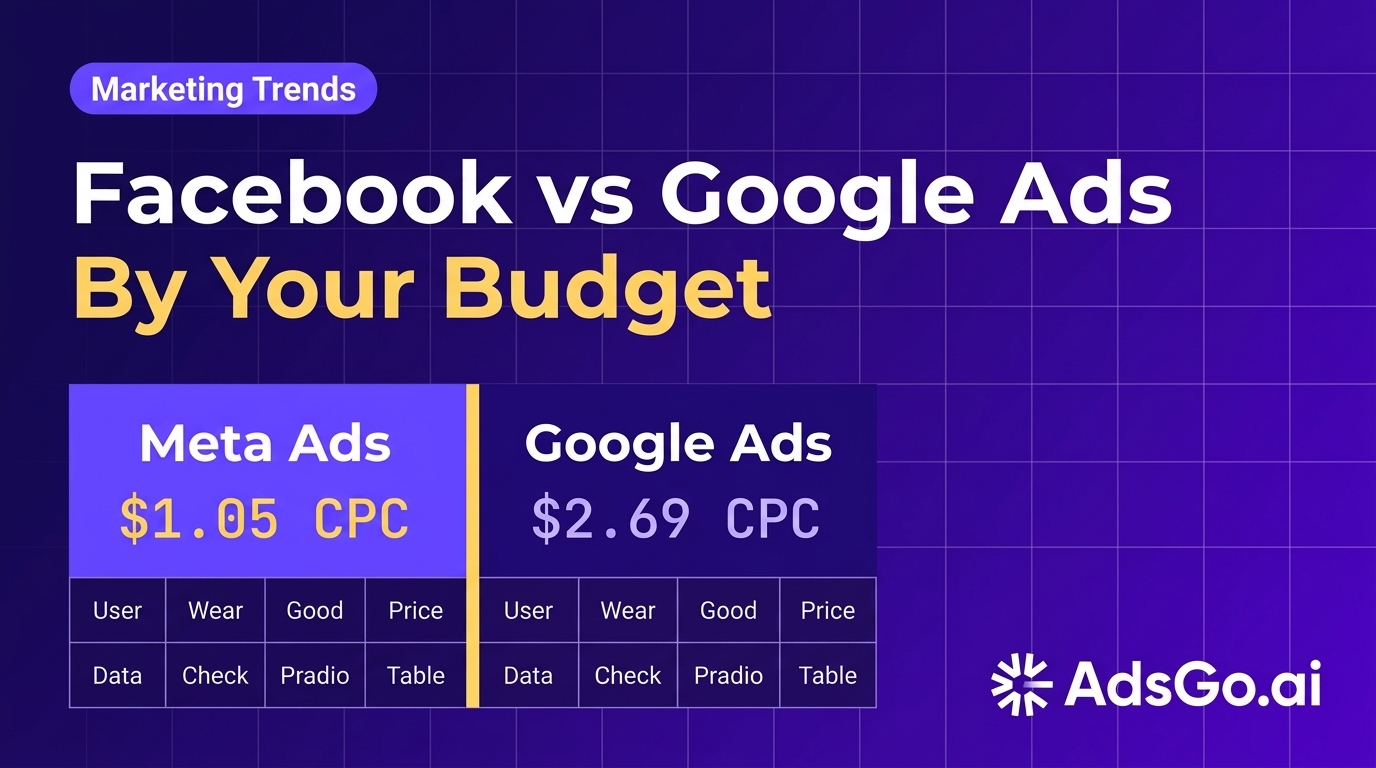
| Cold ecommerce | $1.05 | $2.69 | Meta | Depends on CVR |
| Branded search | N/A | $0.40–$1.20 | ||
| B2B lead gen | $1.80 | $4.50+ | Meta | Often Google |
| Local urgent service | $1.40 | $6–$15 | Meta |
When google ads vs meta ads debates focus only on CPC, they ignore that Google Search traffic often converts at 2–3× the rate of cold Meta feed traffic for the same product. Model CPA with your own landing page conversion rate, not industry averages alone.
Management Time Cost
Platform fees are only part of ad spend decision math. Management cost scales with channel count and creative cadence.
| Task | Google Ads @ $5K/mo | Meta @ $5K/mo |
|---|---|---|
| Weekly optimization | 2–3 hours (negatives, QS, bids) | 2–3 hours (audiences, delivery) |
| Creative production | Low (text RSA) | 3–5 hours (images/video) |
| Reporting reconciliation | 1 hour | 1 hour |
| Cross-channel reallocation | +2 hours if separate dashboards | +2 hours |
At $5K/month, 8–12 hours/month is realistic for which platform for small business teams without automation. That is $800–$1,200 of labor at a $100/hour blended rate — 16–24% of media spend before agency fees.
Teams comparing best third-party tools for google ads with ai features usually want faster bid and budget moves, not another spreadsheet. That is where cross-channel tooling changes the tier math: less time per reallocation means Tier 2 budgets behave like Tier 3 on execution speed.
Budget Decision Tree
Answer in order. Stop at the first rule that matches.
- Is monthly spend under $3,000? → Run one channel only (Tier 1). Use the $1K table above.
- Do 500+ people search your brand monthly? → Add Google branded at 20–30% of budget once Meta prospecting runs.
- Is Meta frequency above 3.5 on cold ads? → Shift 10–15% budget to Google or refresh creative before scaling Meta.
- Is Google impression share below 70% on core terms? → Shift 10% from Meta prospecting to Search.
- Is blended MER (revenue / total ad spend) up 20%+ for 30 days? → Hold split; scale total budget 15–20%, not platform share.
- Is one platform CPA 2× target for 14+ days? → Cut that platform 20%, fix tracking or creative, retest 14 days.
Document decisions in a simple log: date, spend split, MER, action. BCR is a monthly router, not a daily trading algorithm.
Platform Comparison
| Factor | Google Ads | Facebook Ads | AdsGo |
|---|---|---|---|
| Core strength | Captures search intent | Creates demand with creative | Automates both + budget shifts |
| Best at $1K/mo | Yes (if search exists) | Yes (if visual/impulse) | N/A — pick a native channel first |
| Best at $5K/mo | Branded + category capture | Prospecting + retargeting | Cross-channel CPA view |
| Typical operator time | 3–5 hr/week | 4–6 hr/week | Cuts reporting + reallocation time |
| AI optimization | Smart Bidding, PMax | Advantage+, ASC | AI Optimization + Budget Allocation |
| Unified dashboard | Google-only | Meta-only | Ads Manager for Meta + Google |
AdsGo does not replace channel strategy — BCR still decides the split. It reduces the friction of executing that split when you run google and facebook advertising together and need one place to see which side deserves the next dollar.
FAQ
Is Facebook or Google cheaper for small budgets?
Facebook ads usually show lower CPC ($0.80–$1.40 vs $2.00–$3.50 on Google Search). Google often wins on cost per acquisition when buyers already search for your solution. Under $3K/month, cheaper clicks matter less than picking the one channel that can exit learning.
What is the best google ads vs facebook ads split at $5,000/month?
A practical default is 65% Meta and 35% Google: Meta for prospecting and retargeting, Google for branded search plus a small non-brand or Shopping test. Adjust after 14 days using CPA and MER, not CPC alone.
Should I run google ads vs meta ads together at $1,000/month?
No. Splitting $1K across both platforms usually starves learning on each side. Pick one channel, prove CPA for 30 days, then add the second channel when total budget reaches $3K+.
Facebook vs google ads — which is better for ecommerce?
Visual, impulse-friendly ecommerce often starts Meta-heavy at Tier 2. SKU-heavy catalogs with strong search demand add Google Shopping or PMax at Tier 3. Compare MER across channels monthly, not platform ROAS in isolation.
How does google ads and facebook ads ROAS compare?
Reported ROAS is not comparable across platforms because attribution windows and conversion paths differ. Use Marketing Efficiency Ratio (revenue / total ad spend) or incrementality tests instead of trusting either dashboard ROAS alone.
What are the best third-party tools for google ads with ai features?
Look for tools that automate bidding, budget pacing, and creative testing without siloing Google and Meta. AdsGo covers both channels with AI optimization, budget allocation, and a unified ads manager — useful when BCR Tier 2 or 3 splits require weekly reallocation you cannot do manually in 8+ hours.
When should I move from Tier 2 to Tier 3 in BCR?
Move up when each active platform averages 50+ conversions per month for two consecutive months, creative refresh is on schedule, and you have 6+ hours/week (or automation) for cross-channel management. Jumping to Tier 3 early often spreads spend too thin on Google non-brand before branded capture is stable.
Pick your BCR tier, run one channel well before you run two poorly, and reallocate monthly on CPA — not on which platform had the lower CPC last Tuesday.