
$50/day on the wrong PPC advertising channel buys learning, not customers.
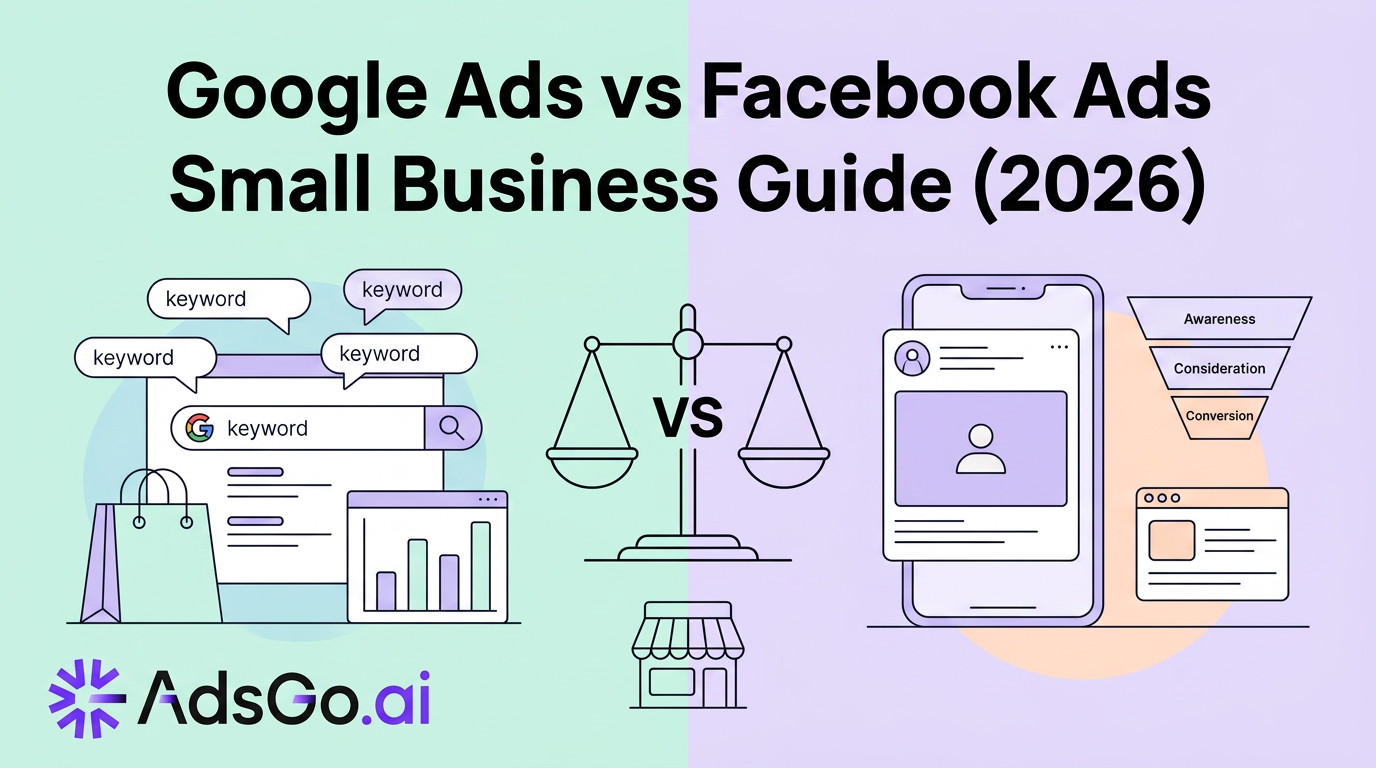
For small businesses, the question is never which platform has the better logo — it's which system matches how people discover and buy your specific offer. Google Ads captures search intent (people who are already looking). Facebook Ads creates demand generation (people who didn't know they needed you yet). These are two different jobs in your conversion funnel, and they require different budget strategies, creative approaches, and success metrics.
This guide gives you the comparison, the honest cost context, and a decision framework you can use today.
TL;DR: Google Ads wins when demand already exists in Search. Meta wins when you must create demand with creative. Running both is normal — but usually as a sequence (demand generation → demand capture) with different ROAS optimization targets, not the same CPA goal on day one.
Quick comparison
| Factor | Google Ads | Facebook / Meta Ads |
|---|---|---|
| User intent | High intent — users search for your product | Discovery — you interrupt their feed |
| Ad type | Text (Search), images/video (Shopping, PMax) | Images, video, carousel, Reels |
| Avg. CPC (2026) | $1–8+ (varies by vertical) | $0.50–$3 (varies by placement) |
| Typical CPA | Higher, but intent-qualified | Lower CPC, longer conversion path |
| Channel role | Demand capture | Demand generation |
| When to start | Product has active search volume | Product needs to be seen to be wanted |
| Learning requirement | Negatives, feed quality, landing page match | Creative iteration, pixel/CAPI health |
| Budget to start | $30–$100/day minimum | $20–$50/day can test creatives |
(Sources: WordStream 2025 benchmarks; Google Ads Help; Meta Business Help)
Running both Google and Meta from two separate dashboards?
What is Google Ads?
Google Ads is a paid search and intent-based PPC advertising platform. Advertisers bid on keywords: when someone searches for a term, matching ads appear above organic results. The conversion funnel logic is simple: the user has already expressed intent by searching, so the ad's job is to be the most relevant answer.
Key campaign types for small business:
- Search campaigns — text ads triggered by queries; highest purchase intent
- Shopping / Performance Max (PMax) — product feed-based; ideal for ecommerce demand capture
- Display & YouTube — visual placements; lower intent, useful for retargeting
What Google Ads rewards: clean conversion tracking, negative keyword discipline, landing page relevance (Quality Score), and sufficient conversion volume to fuel Smart Bidding ROAS optimization.
What it punishes: launching Smart Bidding before enough conversion data exists, thin product feeds, and landing pages misaligned with ad copy.
What is Facebook Ads?
Facebook Ads (now Meta Ads, covering Facebook, Instagram, and Audience Network) is an interest and behavior-based paid media strategy platform. Unlike Google, users aren't searching — you're interrupting their feed. This makes it the primary channel for demand generation: reaching people before they know they want your product.
Key campaign types for small business:
- Advantage+ Shopping Campaigns — AI-driven; good for ecommerce conversion funnel optimization
- Prospecting campaigns — cold audiences; builds top-of-funnel demand
- Retargeting / Custom Audiences — warm audiences; highest ROAS, but dependent on first-party signal quality
What Meta Ads rewards: strong creative that stops the scroll, healthy pixel/CAPI signal (critical post-iOS), and consistent creative refresh cadence to prevent ad fatigue.
What it punishes: weak creative, poor pixel signal from iOS restrictions, and holding the same ROAS expectations as a high-intent search channel.
Google Ads vs Facebook Ads: key differences
The fundamental difference is where the user sits in the conversion funnel:
| Dimension | Google Ads | Facebook Ads |
|---|---|---|
| Search intent | Explicit — user types a query | None — you create the intent |
| Demand type | Demand capture | Demand generation |
| Creative role | Secondary (copy must match intent) | Primary (creative creates desire) |
| Attribution | Cleaner (session intent → conversion) | Longer path (multi-touch, modeled post-iOS) |
| Audience control | Keyword/query-based + RLSA | Interest/behavior/lookalike/Custom |
| Optimization signal | Conversion volume + Quality Score | Pixel/CAPI signal + creative CTR |
| ROAS timeline | Faster for high-intent categories | Slower — needs multi-touch attribution |
| Learning requirement | Structural (negatives, feeds, LP) | Creative throughput + signal hygiene |
The bottom line for paid media strategy:
- Google = answer the query better than anyone else
- Meta = show the right person something compelling they weren't looking for
Cost comparison
Average CPC is a misleading metric for comparing platforms — what matters is cost per acquisition (CPA) and ROAS optimization potential relative to your offer.
| Metric | Google Ads (2026 avg.) | Facebook Ads (2026 avg.) |
|---|---|---|
| Avg. CPC | $1–8+ (search); $0.50–$2 (display) | $0.50–$3 (feed/stories) |
| Avg. CPM | $6–$12 | $5–$15 |
| Avg. CPA (ecommerce) | $30–$70 | $20–$50 |
| Avg. CPA (B2B / SaaS) | $80–$200+ | $60–$150+ |
| Avg. ROAS (ecommerce) | 3–6x | 2–4x |
(Sources: WordStream Facebook benchmarks, WordStream Google Ads benchmarks, 2025 data)
Why "same ROAS" comparisons mislead: Google can convert in-session for high-intent queries. Meta often needs 3–5 touchpoints across days. If you apply the same 7-day click attribution window with the same ROAS target, you'll systematically undervalue Meta's role in the conversion funnel. Use channel-appropriate KPIs:
- Google Search: session CPA, ROAS within 7-day click
- Meta prospecting: blended CPA, new customer acquisition cost
- Meta retargeting: ROAS within 1-day view + 7-day click
For a deeper cost breakdown by campaign type, see our guide on how to set Google Ads budget without wasting money.
Which is better for ecommerce?
For most ecommerce stores, the answer is both — but in sequence, not simultaneously from day one.
Start with Google Ads when:
- Your products have active search demand ("buy [product name]" queries exist)
- You have a product feed ready for Shopping or PMax
- Average order value is high and purchase intent drives conversion
- Your category is commodity or search-driven (electronics, tools, supplements)
Start with Meta Ads when:
- Your product must be seen to be wanted — visual discovery drives desire
- You sell impulse-friendly items or novel products with low search volume
- Your target audience isn't actively searching yet (new category, lifestyle brand)
- You need demand generation before demand capture makes sense
The typical paid media strategy at scale:
| Channel | Role | Budget allocation |
|---|---|---|
| Google Shopping / PMax | Demand capture — high intent | 55–65% |
| Google Search (brand) | Brand defense | 5–10% |
| Meta prospecting | Demand generation — new audiences | 20–25% |
| Meta retargeting | Warm conversion funnel | 10–15% |
Adjust based on your category dynamics and margin. Ecommerce with commodity SKUs skews more Google; lifestyle and visual brands often skew more Meta.
For the full setup guide, see how to run Google Ads for ecommerce.
Which is better for small business?
There is no universal winner — better means fit. Here's the decision logic:
Choose Google Ads first if:
- Your customers know they need your category (demand already exists)
- You offer services with urgent intent: emergency plumbers, local services, repairs
- You sell products people search for before buying
- Your conversion funnel is short (same-session purchase or call)
Choose Meta Ads first if:
- Your brand or product isn't widely known yet
- You need to build a customer base through demand generation
- Your offer is visual, lifestyle-driven, or impulse-friendly
- You have strong creative capacity (video, lifestyle images)
- Your target audience is definable by demographics, interests, or life events
Industry patterns for small business PPC advertising:
| Business type | Recommended start | Reason |
|---|---|---|
| Local emergency services | Google Search | High search intent, immediate need |
| Visual lifestyle brand | Meta | Demand generation through discovery |
| B2B / professional services | Google Search | Problem-aware queries exist |
| New consumer product | Meta first, then Google | Build demand before capturing it |
| Ecommerce (commodity) | Google Shopping | Feed-based demand capture |
| Ecommerce (novel/visual) | Meta first | Discovery-led conversion funnel |
Key mistakes to avoid:
- Judging Meta on a Search-speed conversion window (different attribution logic)
- Running PMax or broad Meta before conversion volume supports automated bidding
- Copying a competitor's 50/50 budget split without matching their margin and creative team size
Budget strategy for running both channels
Once one channel reaches a stable CPA or ROAS band you trust, fund the second channel as a test slice — not an even split on day one.
Phase 1 — Single channel (months 1–3):
- Choose one platform based on the decision framework above
- Focus: learn conversion funnel, establish ROAS baseline, build retargeting audiences
- Minimum: $30–$50/day to generate meaningful learning data
Phase 2 — Add second channel (months 3–6):
- Allocate 20–30% of total paid media budget to the new channel
- Keep channels separate KPIs — don't expect Meta to match Google Search ROAS immediately
- Duration: 4–8 weeks before evaluating channel fit
Phase 3 — Optimize the full paid media strategy:
- Assign explicit roles: prospecting (Meta) vs. capture (Google)
- Shift budget based on ROAS optimization data, not platform preference
- Monitor blended CPA across both channels, not just per-channel metrics
Budget split benchmarks by business type:
| Monthly budget | Suggested split |
|---|---|
| Under $3,000 | One channel only — master it first |
| $3,000–$8,000 | 70/30 toward proven channel + test slice |
| $8,000–$20,000 | 60/40; separate conversion funnel tracking per channel |
| Over $20,000 | Flexible by category; use blended ROAS optimization |
Decision framework
Use this to make the channel decision in under 2 minutes:
Step 1: Does your product have active search demand?
- Yes → Google Ads first (demand capture)
- No → Meta Ads first (demand generation)
Step 2: What is your conversion funnel speed?
- Fast (same session) → Google Search, Shopping
- Slow (multi-touch, days to weeks) → Meta + retargeting
Step 3: What is your creative capacity?
- Strong creative team → Meta can scale faster
- Limited creative → Google Search (copy-based, lower creative bar)
Step 4: What is your budget?
- Under $3,000/month → one channel; master the conversion funnel first
- Over $3,000/month → sequence both with separate KPIs
Step 5: What does your category look like? → Use the industry cheat sheet:
| Category | Lead channel | Why |
|---|---|---|
| Emergency / local services | Google Search | Search intent is the purchase trigger |
| Ecommerce (known SKU) | Google Shopping | Feed-based demand capture |
| Ecommerce (visual/lifestyle) | Meta first | Demand generation drives discovery |
| SaaS / B2B | Google Search + Meta nurture | Problem-aware queries + longer funnel |
| New consumer product | Meta, then Google | Build demand before you can capture it |
If you already run both channels and want one operating view for spend, ROAS, and creative performance across your paid media strategy, tools like AdsGo Ads Manager provide cross-platform visibility.
Related guides
- Google Ads for ecommerce: How to run Google Ads for ecommerce stores — Shopping vs PMax, feed hygiene, ROAS targets
- Scale Facebook Ads: How to scale Facebook Ads without losing ROAS — vertical vs horizontal scaling, budget rules
- AI tools for both channels: Best AI tools for Google Ads in 2026 — by bottleneck and use case
- Automate Google Ads: Stop managing Google Ads manually — smart bidding, rules, AI orchestration
- Facebook Ads audience strategy: How to find your Facebook Ads target audience — 3-layer cold/warm/hot framework
FAQ
Google Ads vs Facebook Ads — which is better for small business?
There is no universal answer. Google Ads wins when search intent exists for your product; Facebook Ads wins when you need demand generation. Most SMBs eventually use both — but start with one channel until your conversion funnel and tracking are stable.
Is Facebook Ads cheaper than Google Ads?
CPC on Meta is typically lower in benchmarks, but CPA depends on offer, creative quality, and conversion funnel length. Compare CPA and contribution margin, not CPC alone. A $1.50 Meta click that takes 8 touches to convert may cost more per acquisition than a $5 Google click that converts in-session.
How much budget do I need to start PPC advertising?
For Google Search: $30–$100/day minimum to generate conversion data for Smart Bidding. For Meta: $20–$50/day can test 2–3 creative variants. Below these thresholds, learning is too slow to optimize ROAS effectively.
When should I run both Google Ads and Facebook Ads?
Add the second channel when your first channel has a stable, trusted CPA or ROAS baseline — typically after 60–90 days. Splitting budget too early means slower learning on both. Assign separate roles: Meta for demand generation (prospecting), Google for demand capture (search/shopping).
What is the difference between demand generation and demand capture?
Demand capture (Google Search) means intercepting people who already want what you sell. Demand generation (Meta) means showing your product to people who don't know they need it yet. A complete paid media strategy needs both — but at different funnel stages and with different ROAS optimization expectations.
What changed for PPC advertising in 2026?
More automation (PMax, Advantage+), more modeled conversions where raw signal is limited post-iOS, and higher creative cadence requirements on Meta. Both platforms now require more conversion volume before Smart Bidding or Advantage+ can optimize effectively. Plan for 4–8 week learning phases, not overnight results.