
A 0.3% CTR isn't just underperforming — it's costing you more per click than your competitors pay, because Meta's auction system rewards high-engagement ads with lower CPMs. Low CTR is a tax on every dollar you spend.
Before you change your audience or raise your budget, you need to know what "low" actually means for your placement and industry. Most advertisers are benchmarking against the wrong number.
CTR Benchmarks by Industry and Placement
CTR varies dramatically across industries and placements. A 0.9% CTR in ecommerce is mediocre. The same 0.9% in B2B SaaS is exceptional. Comparing your performance against a generic average will lead you to the wrong diagnosis.
Industry CTR Benchmarks (Facebook Feed, 2025–2026)
These benchmarks reflect click-through rates on the "Link Click" metric in Ads Manager, not "All Clicks" (which includes post reactions and shares). (Source: WordStream Industry Benchmarks, 2025)
| Industry | Average CTR | Good CTR |
|---|---|---|
| Ecommerce | 1.2% | 2.0%+ |
| Retail | 1.6% | 2.5%+ |
| Fashion / Apparel | 1.4% | 2.2%+ |
| Health & Wellness | 1.1% | 1.8%+ |
| SaaS / Software | 0.8% | 1.4%+ |
| B2B Services | 0.6% | 1.1%+ |
| Education | 0.7% | 1.2%+ |
| Finance | 0.5% | 0.9%+ |
| Real Estate | 0.9% | 1.5%+ |
| Travel | 1.8% | 3.0%+ |
Placement CTR Benchmarks
| Placement | Average CTR |
|---|---|
| Facebook Feed | 1.0–1.5% |
| Instagram Feed | 0.6–1.2% |
| Facebook Reels | 0.4–0.8% |
| Instagram Stories | 0.3–0.6% |
| Facebook Right Column | 0.1–0.3% |
| Audience Network | 0.2–0.5% |
The Right Column and Audience Network placements have structurally lower CTRs. If you're running Advantage+ Placements and these are included, they'll pull your blended CTR down significantly — which can look like a creative problem when it's actually a placement mix issue.
3 early CTR decline signals
Most advertisers notice CTR problems after a week of poor performance. These three leading indicators appear 2–3 days earlier:
Signal 1: Frequency above 2.0 with stable CTR. When frequency climbs past 2.0 but your CTR hasn't dropped yet, you have 3–5 days before decline accelerates. The creative is still working, but the same users are being retargeted — and their attention is waning.
Signal 2: Relevance score declining. Meta's ad relevance diagnostics (visible in Ads Manager under the Quality Ranking column) rate your ad's quality and resonance. A decline from "Above Average" to "Average" precedes a CTR drop by 1–2 days.
Signal 3: CPM increasing without additional competition. Rising CPM from the same audience at the same time of day usually means Meta is detecting lower user response signals — less hover time, lower engagement rate on the ad — and charging more to reach the remaining responsive users.
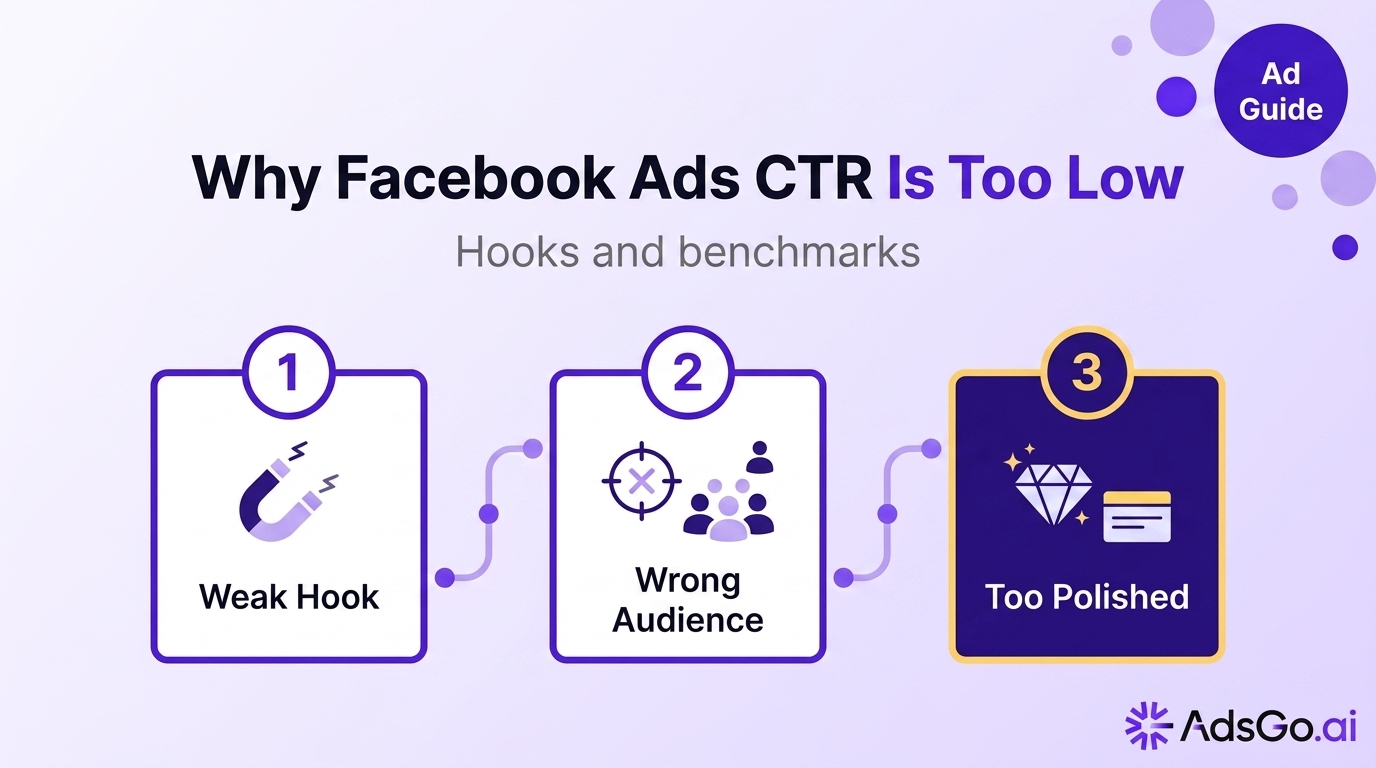
The 3 Creative Failure Modes Behind Low CTR
Failure Mode 1: The Hook Doesn't Stop the Scroll
The first 1–3 seconds of any Facebook ad are the only seconds that matter for CTR. Users scroll 300 feet of content per day on Facebook (industry estimate). A hook that doesn't arrest attention in the first frame generates sub-0.5% CTR regardless of how good the rest of the ad is.
Weak hooks share common characteristics: generic product shots, no text overlay on video, benefit statements that apply to everyone ("Get More Sales"), or visual styles that blend into editorial content rather than standing out.
Strong hooks use one of four psychological triggers:
- Pattern interrupt: Something visually unexpected that breaks scroll momentum
- Specific problem: "If your Facebook ads keep running out of budget by noon, this is why"
- Social proof quantification: "We spent $2.3M testing this. Here's what actually works."
- Curiosity gap: Information that feels incomplete without clicking
Failure Mode 2: Audience-Creative Mismatch
Your creative has a great hook — but for the wrong audience. This produces CTR that looks acceptable in aggregate but terrible when segmented by audience. A creative designed for 35–55 year-old homeowners will underperform if served to 22-year-old renters, even if both are "interested in home improvement."
The creative's visual language, character representation, pain points, and price anchoring all need to match the specific audience segment.
Diagnosis: Break down CTR by age and gender in Ads Manager's Breakdown menu. If CTR drops sharply for specific demographic segments, you have an audience-creative mismatch for those segments — not a global creative problem.
Failure Mode 3: Ad Looks Too Much Like an Ad
Meta users have become exceptionally good at detecting advertising intent and scrolling past it. Highly produced, polished ad creative often underperforms lo-fi, authentic-feeling content — particularly for cold audiences.
Stock photo imagery, corporate-style design templates, and formal copywriting all signal "advertisement" to users who have seen thousands of similar formats. The algorithm also penalizes ads that receive high rates of user "Hide Ad" or "Report Ad" feedback, reducing CTR through the quality penalty in the auction.
The test: Remove all text overlays and branding from your current best-performing ad. Does it look like something a user would organically post? If not, it's at risk of the "too polished" penalty.
Ready to Launch Smarter Campaigns?
The Hook Optimization Framework
The Hook is the only element of an ad that determines whether a user stops scrolling. Optimizing the hook is the highest-leverage action for improving CTR.
Hook Structure by Ad Format
Static image ads: The hook is the image + headline combination. The image must create visual curiosity or recognition, and the headline must answer "why does this matter to me?" within 5 words.
Video ads: The hook is the first 3 seconds of video. No logo intro. No slow fade-in. The most important frame of the video must appear in the first second — whether that's a provocative statement, a surprising visual, or the final result of your product demo.
Carousel ads: The hook is the first card. Treat it as a standalone static image ad — it must earn the swipe before subsequent cards matter.
Hook Testing Process
Test one variable at a time to understand what's driving performance differences:
Test 1: Hook type. Create 4 variants of the same ad with different hook types: problem-focused, curiosity-gap, social proof, and transformation. Keep everything else identical. Run for 5 days minimum.
Test 2: Hook format. Take your winning hook type and test it as text-on-image vs. no-text image vs. video hook. The format that performs varies significantly by audience and objective.
Test 3: Hook specificity. Generic hooks ("Improve your ads") always lose to specific hooks ("Cut your Facebook CPA by 40% without reducing spend"). Test the specificity level of your winning hook type.
The A/B Testing System for CTR
Run CTR A/B tests within Meta's built-in A/B testing tool (not by creating duplicate campaigns, which introduces auction competition). Meta's A/B test tool distributes traffic between variants without overlap.
Test parameters to use:
- Duration: 7–14 days minimum. CTR data on days 1–3 is unreliable.
- Budget: Each variant needs enough budget for statistical significance. A rule of thumb: $50–100 minimum per variant before drawing conclusions.
- Variable isolation: Test one element per experiment. Testing both hook type and creative format simultaneously makes it impossible to attribute the performance difference.
When you have a winning variant with at least 95% statistical confidence in Meta's A/B tool, pause the losing creative and allocate 100% of budget to the winner. Then start a new test against the winner.
CTR below industry benchmark? AdsGo tests hook variations and refreshes creative to lift click-through rate. → Try AdsGo free
How AdsGo automates CTR recovery
Manually running A/B tests, tracking CTR signals, and rotating creatives across 10+ campaigns requires a level of operational bandwidth that few teams maintain.
AdsGo's auto-creative system monitors CTR performance across all Meta campaigns and automatically flags creatives that are underperforming relative to placement benchmarks. When a creative's CTR drops below the industry threshold for its placement, AdsGo surfaces a replacement recommendation with specific hook format and copy direction.
AdsGo's AI optimization integrates CTR data into the bid management system — ads with higher CTR receive algorithmic bid adjustments that capitalize on Meta's quality bonus in the auction formula, compounding the CTR advantage into lower CPC. (based on AdsGo internal campaign data)
FAQ
What is a good CTR for Facebook ads in 2026?
It depends on your industry and placement. For Facebook Feed ads, a good CTR across most industries is 1.0–2.0%. Ecommerce and retail can see 2–3%+ with strong creative. B2B and finance will be below 1.0% even with excellent creative. Always compare against industry-specific benchmarks, not the generic Facebook average.
My Facebook ad CTR was good last week but dropped suddenly — what happened?
Sudden CTR drops after a period of good performance are almost always creative fatigue. Your audience has seen the ad multiple times and engagement is waning. Check your frequency metric — if it's above 2.5 in the past 7 days, refresh your creative. Also check if Meta made any delivery system updates, which can occasionally cause temporary CTR fluctuations.
Should I use "All Clicks" or "Link Clicks" for measuring CTR?
Use Link Clicks CTR (Link Click-Through Rate) for performance measurement. "All Clicks CTR" includes post reactions, shares, and clicks on your profile name — none of which indicate purchase intent. Link CTR measures only clicks on your ad's destination URL, which is the only click that drives traffic to your landing page.
How many creatives should I test at once?
Test 3–5 creative variants per ad set. Testing more than 5 simultaneously dilutes the budget per variant and makes it harder to reach statistical significance quickly. Test fewer variables at a time with adequate budget per variant, then iterate on winners.
Does audience size affect CTR?
Indirectly, yes. Very small audiences (under 100K) often show higher initial CTR because targeting is precise, but CTR declines faster as frequency builds. Very large audiences (5M+) show lower initial CTR but sustain it longer as the algorithm finds new user segments continuously. The optimal balance for most campaigns is an audience of 500K–1M.