
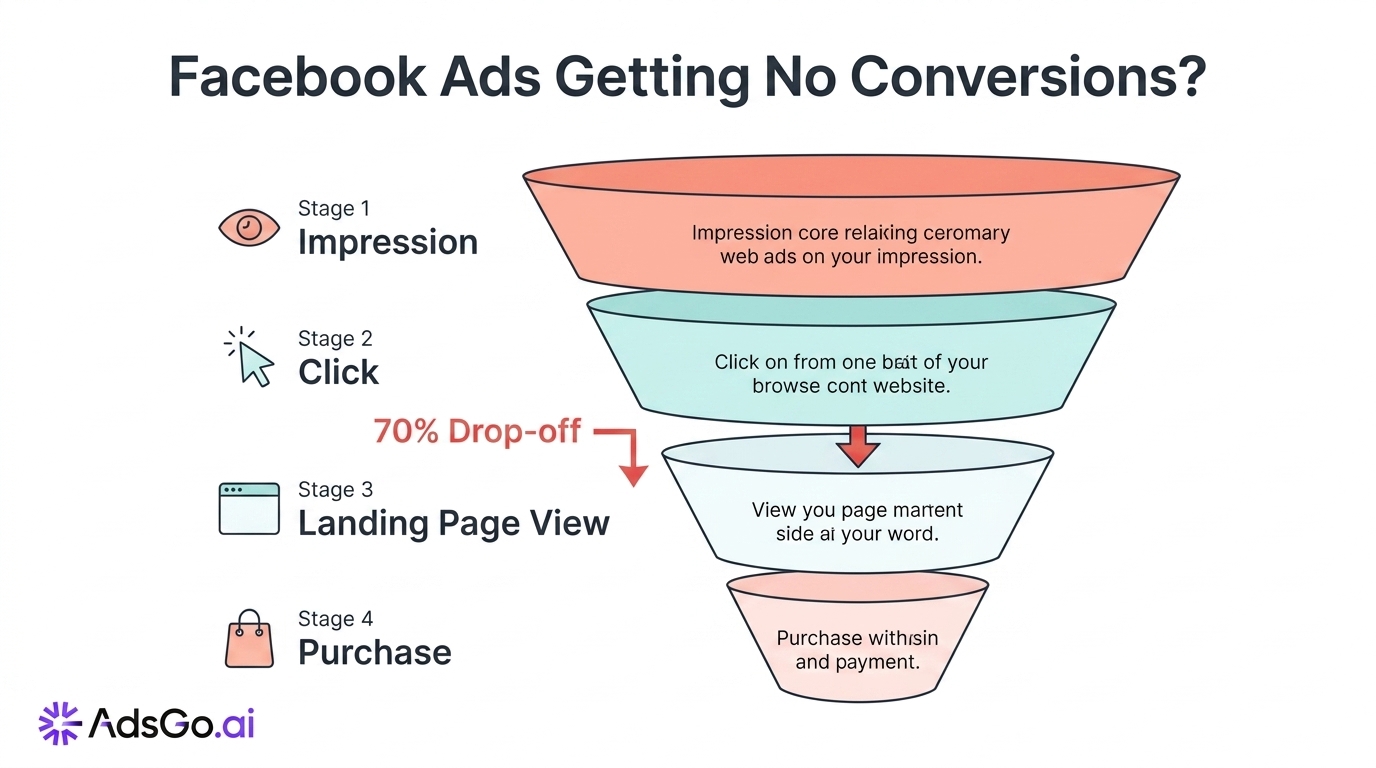
Running Facebook ads with zero conversions isn't always a Facebook problem. In most cases, the ad itself is working fine — it's getting clicks — but something between the click and the conversion is broken. Finding that break point is the entire job.
The mistake most advertisers make is treating "no conversions" as a single problem with a single fix. It's not. It's a funnel problem, and the fix depends entirely on which stage of the funnel is failing.
The Funnel Breakdown Model
Every conversion path has four stages, and each stage can fail independently. Working backwards from zero conversions without knowing which stage is broken leads to random changes that may fix nothing.
Stage 1: Impression → Click
The question: Is your ad generating clicks at a reasonable rate?
Check your CTR in Ads Manager. Industry average for Facebook feed ads is 0.9–1.5% (Source: WordStream, 2025). If your CTR is below 0.5%, the issue is at the impression-to-click stage — users see your ad but don't engage with it.
This stage fails when: the creative doesn't match the audience's expectations, the hook doesn't create curiosity or urgency, or the ad looks like an ad rather than native content in the feed.
Stage 2: Click → Landing Page View
The question: Of people who click, how many actually load your landing page?
This metric lives in your Ads Manager as "Landing Page Views" vs. "Link Clicks." If you're getting 200 link clicks and 60 landing page views, you're losing 70% of your traffic before they see your offer. The gap between clicks and landing page views is almost always a page load speed issue — slow pages cause users to abandon before the Pixel fires.
A 3-second page load loses 40% of mobile visitors before they see any content. (Source: Google / SOASTA) Meta's mobile-first audience is especially sensitive to load time.
Stage 3: Landing Page View → Purchase (or Lead)
The question: Of people who reach your landing page, what percentage convert?
This is the most complex stage. A 1–3% conversion rate is typical for cold traffic ecommerce (industry estimate). Below 0.5% indicates a landing page problem: mismatched messaging, weak offer, trust barriers, or a checkout flow that loses people.
Stage 4: Purchase → Reported Conversion
The question: Is your Pixel correctly tracking and reporting conversions that actually happen?
Pixel tracking failures are more common than most advertisers realize. If conversions are happening but not being attributed to your campaigns, you'll see revenue in your payment processor but zero in Ads Manager. This doesn't cause no conversions — it causes underreported conversions, which leads to the algorithm not being able to optimize correctly, which eventually causes real conversion decline.
Facebook ads getting clicks but zero conversions?
Detecting Each Stage's Breakpoint
How to Read the Data for Each Stage
Pull these metrics from Ads Manager for a 7-day window to map your funnel:
| Stage | Metric to Check | Warning Threshold |
|---|---|---|
| Impression → Click | CTR (Link) | Below 0.5% |
| Click → LP View | LP View Rate (LP Views ÷ Link Clicks) | Below 70% |
| LP View → Conversion | Conversion Rate (Conversions ÷ LP Views) | Below 0.5% for cold traffic |
| Purchase → Reported | Pixel event volume vs. actual orders | More than 15% discrepancy |
Check these metrics in this order before making any campaign changes. Don't adjust your Facebook targeting if the problem is your landing page. Don't rebuild your landing page if your Pixel isn't tracking.
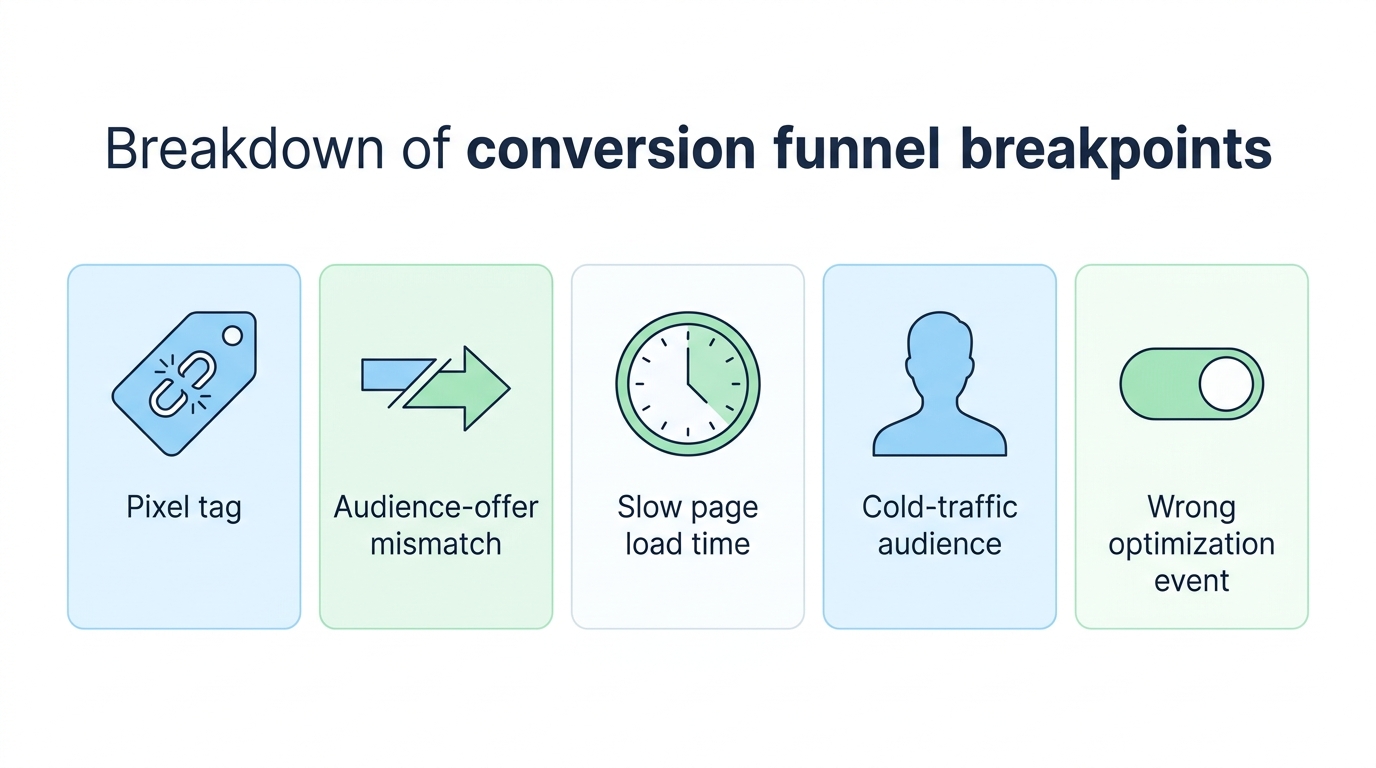
The 5 Most Common Conversion Breakpoints
Breakpoint 1: Pixel Not Firing on Purchase
The most impactful — and most overlooked — conversion issue. Pixel tracking breaks for several reasons: code installed on the wrong page (order confirmation vs. cart page), Pixel events not passing purchase value, or iOS 14+ privacy changes blocking attribution.
Verify using Meta Pixel Helper (Chrome extension) and Events Manager → Test Events. Send a test purchase through your checkout and confirm the "Purchase" event fires with the correct value. If it doesn't, your campaign has been flying blind on optimization data.
Fix: Reinstall Pixel via Meta's Conversions API (CAPI) in addition to the browser Pixel. CAPI bypasses browser-side tracking limitations and dramatically improves attribution accuracy under iOS 14+ privacy restrictions.
Breakpoint 2: Audience-Offer Mismatch
Your ad gets clicks because the creative is compelling, but visitors don't convert because the offer doesn't match what the ad promised. This is the "bait and switch" problem — not intentional, but common.
Example: Your ad shows a 40% discount on running shoes. Your landing page is a generic homepage with no visible discount. The user who clicked for a specific discount leaves immediately.
Fix: Create dedicated landing pages for each major audience segment. Cold audience ads should link to pages that establish trust and explain the offer clearly. Retargeting ads should link to pages that reference the user's previous action ("You left something behind").
Breakpoint 3: Landing Page Loads Too Slowly
Google's Core Web Vitals research consistently shows that every 100ms of additional page load time reduces conversion rates by approximately 1%. (Source: Deloitte Digital Performance, 2020) A page that loads in 5 seconds vs. 2 seconds could be operating at 30% of its potential conversion rate.
Fix: Run your landing page through PageSpeed Insights (Google's free tool). Compress images to under 100KB, enable browser caching, and use a CDN for static assets. On Shopify and most landing page builders, these optimizations can be configured without code changes.
Breakpoint 4: Offer Not Compelling Enough for Cold Traffic
Warm traffic (website visitors, customer lists) converts at 3–8×the rate of cold traffic because they already know your brand. Cold traffic requires a much stronger offer to convert on the first visit.
If you're running cold traffic campaigns and expecting the same conversion rate you get from retargeting, you'll always see "no conversions."
Fix: For cold traffic, lead with a lower-commitment offer — free trial, lead magnet, or a strong first-purchase discount. Save your standard offer for retargeting campaigns where users have already expressed intent.
Breakpoint 5: Wrong Optimization Event
If you're optimizing for Purchases but Meta doesn't have enough purchase data to find converters, the algorithm defaults to optimizing for engagement (clicks, video views) which don't correlate with purchase intent.
This creates a scenario where you get clicks from users who will never buy — your CTR looks healthy, but conversions are zero.
Fix: If you're generating fewer than 30 purchases per week, switch your optimization event to Add to Cart or View Content. Once your account matures and purchase data increases, migrate the optimization event back to Purchase.
Funnel data scattered across Ads Manager, Analytics, and your payment processor? AdsGo consolidates every conversion breakpoint into one view and alerts you before spend is wasted. → See how it works
The Conversion Repair System
Once you've identified which stage is failing, apply fixes in this sequence:
Priority 1 (fix before anything else): Verify Pixel tracking. If your data isn't reliable, no optimization decision you make will be based on reality.
Priority 2: Fix the stage with the largest percentage drop-off. A 30% CTR (click-to-LP-view) gap is more impactful to fix than a 1% CTR improvement on the ad.
Priority 3: Match your optimization event to your conversion volume. Don't optimize for an event you can't generate enough of.
Priority 4: Test landing page variants. A/B test the single biggest variable (headline, offer, CTA) before testing multiple elements simultaneously.
How AdsGo Surfaces Conversion Funnel Breakpoints
Manually calculating click-to-view rates, LP view-to-conversion rates, and cross-referencing Pixel event data across multiple campaigns requires pulling data from Ads Manager, Google Analytics, and your CRM simultaneously.
AdsGo's ad insight dashboard consolidates all funnel metrics into a single view, automatically flagging which stage is underperforming relative to industry benchmarks. When your LP View rate drops below 65% or your conversion rate falls below 0.5% for cold traffic, AdsGo surfaces the alert before it becomes a week of wasted spend.
AdsGo's AI optimization also monitors optimization event selection across your campaigns, flagging situations where your current event doesn't match your conversion volume — and recommending the appropriate event level to keep the algorithm in its optimal learning state.
FAQ
My Facebook ads are getting clicks but no conversions — what should I check first?
Start with Pixel verification. Open Meta Pixel Helper in Chrome and go through your checkout process. Confirm the "Purchase" event fires correctly with the right value. If Pixel tracking is broken, your conversion data in Ads Manager is unreliable and optimization decisions made on that data will be wrong.
Why did my Facebook ads suddenly stop converting after working well?
Sudden conversion drops after a period of good performance usually indicate creative fatigue (audience has seen your ad too many times), audience saturation, or a landing page change that introduced friction. Check your frequency metric — if it's above 3.5 in the past 7 days, creative fatigue is likely the culprit.
How long should I wait before concluding Facebook ads aren't converting?
Statistical significance matters. For most campaigns with $50–200/day budgets, you need 7–14 days and at least $300–500 in spend before drawing conclusions about conversion performance. Drawing conclusions after 2 days and $50 spend is premature — the data isn't statistically meaningful yet.
Does audience targeting affect conversion rate?
Significantly. A perfectly optimized ad for the wrong audience will generate clicks from people who will never buy. Cold interest audiences convert at 0.5–2%. Lookalike audiences of past customers convert at 2–4%. Retargeting audiences of website visitors convert at 3–8%. Matching your offer and landing page to the audience's level of brand awareness is critical for conversion rate.
Can running too many ads hurt conversions?
Yes, in two ways. First, budget fragmentation: spreading $100/day across 10 ad variants means each variant gets $10/day, which isn't enough data for Meta to optimize any of them effectively. Second, audience overlap: multiple ads targeting the same audience compete with each other in the auction, inflating your costs and reducing delivery quality. Consolidate to 3–5 strong creative variants per ad set.