
ROAS of 2.5× means you're spending $1 to make $2.50. Whether that's good depends on your margins. For a 60% gross margin business, 2.5× ROAS is profitable. For a 25% gross margin business, 2.5× ROAS means you're losing money on every ad dollar.
This is why ROAS optimization has to start with the profit equation — not with arbitrary targets pulled from industry benchmarks. The right ROAS for your business is specific to your margin structure.
The ROAS Driver Model
ROAS = Revenue ÷ Ad Spend
But that formula is too simplified to optimize against. The actual driver model is:
ROAS = (AOV × CVR × Traffic Volume) ÷ Total Ad Spend
Where:
- AOV (Average Order Value) is what customers spend per purchase
- CVR (Conversion Rate) is the percentage of ad visitors who purchase
- Traffic Volume is the number of qualified visitors your ad delivers
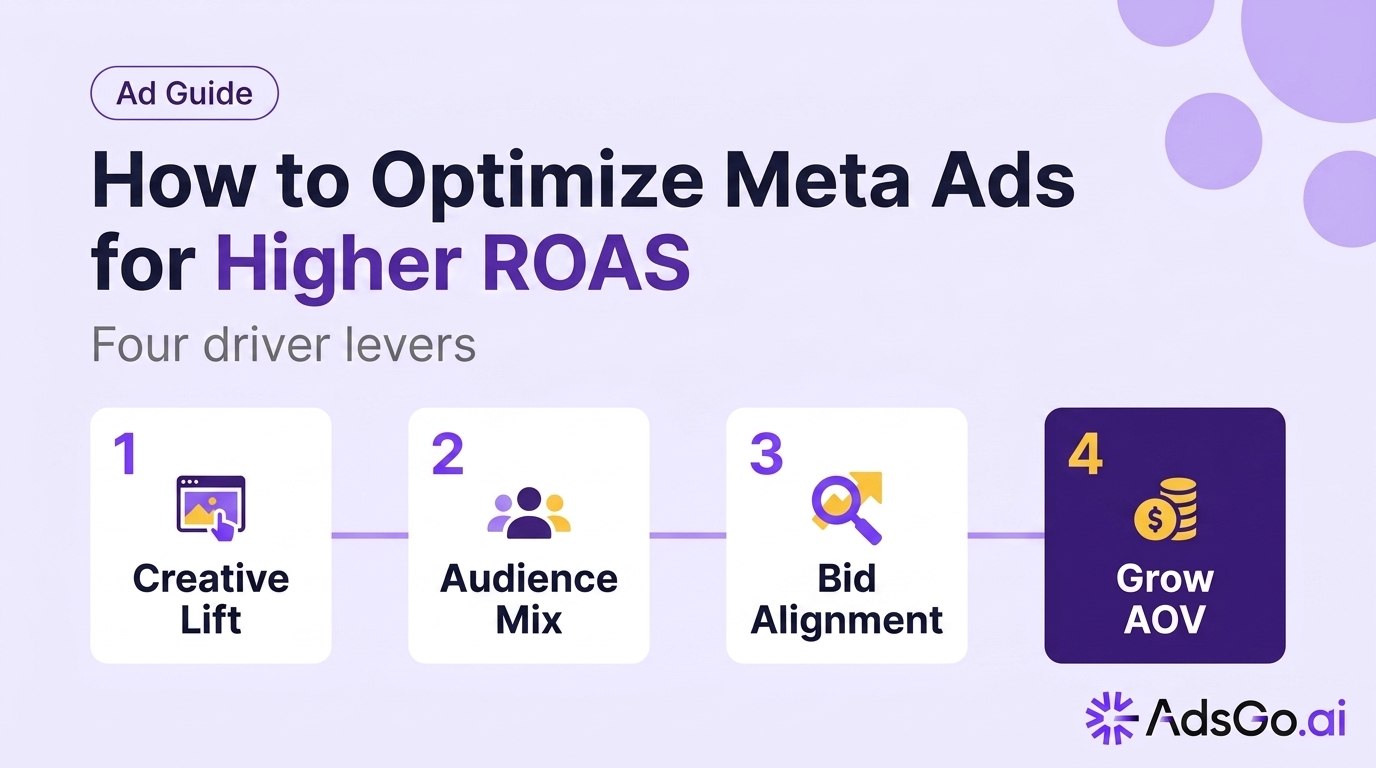
This model reveals that ROAS can be improved through three independent levers: increasing what customers spend (AOV), improving how many visitors convert (CVR), or reducing the cost of acquiring each visitor (CPC, which reduces spend for the same traffic volume).
Most advertisers focus exclusively on CVR. This is correct as a starting point, but AOV and CPC improvements often have faster and larger ROAS impact.
The Profit Equation: Your Break-Even ROAS
Before optimizing for a higher ROAS, calculate the minimum ROAS you need to be profitable:
Break-Even ROAS = 1 ÷ Gross Margin
If your gross margin is 40% (you keep $0.40 of every revenue dollar after product cost): Break-even ROAS = 1 ÷ 0.40 = 2.5×
Any ROAS above 2.5× is profitable. Any ROAS below 2.5× is a loss.
To target a specific profit margin, add it to the calculation:
Target ROAS = (1 + Target Margin %) ÷ Gross Margin %
For a 40% gross margin business targeting 15% net profit from ads: Target ROAS = (1 + 0.15) ÷ 0.40 = 2.875×
This is your real ROAS target — not the industry average, not what your competitor claims to hit. Every optimization decision should be judged against this number.
Industry ROAS Benchmarks (Meta Ads, 2025–2026)
For context, here are typical ROAS ranges by industry. (Source: WordStream, 2025; industry estimate)
| Industry | Average ROAS | Strong ROAS |
|---|---|---|
| Ecommerce (general) | 2.5–3.5× | 4.5×+ |
| Fashion / Apparel | 2.0–3.0× | 4.0×+ |
| Health & Wellness | 2.0–2.8× | 3.5×+ |
| Home & Garden | 2.5–4.5× | 5.0×+ |
| Electronics | 3.0–4.5× | 6.0×+ |
| SaaS (LTV-adjusted) | 1.0–2.0× | 3.0×+ |
Note that SaaS ROAS is often below 2× on a first-purchase basis because the subscription LTV justifies higher acquisition cost. Compare against your break-even ROAS, not these benchmarks.
The 4-Step ROAS Optimization Framework
Step 1: Creative Optimization (Impact on: CVR, CTR)
Creative is the single largest variable in Meta ROAS performance. In our analysis of 500+ campaigns at AdsGo, creative quality accounted for 47% of ROAS variance between high and low performing ad accounts with similar audiences and budgets. (based on AdsGo internal campaign data)
High-ROAS creative has three consistent characteristics:
- Specificity: Shows the exact product in the exact context the buyer will use it
- Social proof: Displays authentic results (reviews, testimonials, before/after in compliant categories)
- Friction reduction: Answers the buyer's most likely objection within the creative itself
The creative refresh cadence matters as much as creative quality. Ads left running past their effective window (typically when frequency exceeds 2.5–3.0 for the primary audience) see ROAS decline 20–30% before the algorithm signals fatigue. Proactive refresh before this threshold preserves ROAS stability.
Step 2: Audience Architecture (Impact on: CVR, CPC)
ROAS varies dramatically by audience segment because different audiences have different purchase intent and willingness to pay.
Cold audiences (Interest, Broad): Lowest CVR, highest reach. Best for prospecting and building the funnel. ROAS is typically lowest here, but cost per new customer relationship is the relevant metric.
Warm audiences (Website visitors, Engagement): Moderate CVR, moderate reach. These users have expressed some intent. ROAS is typically 1.5–2× higher than cold audiences.
Hot audiences (Cart abandoners, Past purchasers, High-value visitors): Highest CVR, smallest reach. ROAS from retargeting campaigns is typically 3–8× higher than cold prospecting.
Budget architecture for ROAS optimization: allocate 60–70% of budget to cold prospecting (fills the funnel), 20–25% to warm retargeting, and 10–15% to hot retargeting (maximizes ROAS on existing intent).
Inverting this allocation — spending most budget on retargeting — produces high ROAS in the short term but starves the top of funnel, causing retargeting audiences to shrink and ROAS to decline within 4–6 weeks.
Step 3: Bidding Strategy Alignment (Impact on: CPC, Scale Constraints)
Your bidding strategy should match your campaign's maturity and data volume:
Lowest Cost (no cap): Best for new campaigns and accounts with fewer than 50 conversions/week. Maximizes conversion volume to build optimization data, even if CPA is above target temporarily.
Cost Cap: Use when you have 50+ weekly conversions and a defined maximum CPA. Set the cap at 15–20% above your target CPA, not at your target — caps set too tight reduce delivery and prevent the algorithm from capitalizing on high-quality conversion opportunities.
Value Optimization with ROAS Goal: Available when Meta has sufficient purchase value data (typically 100+ purchases with value passed via Pixel). Directly optimizes for ROAS rather than CPA. This is the most direct lever for ROAS improvement but requires the data volume to activate it.
Step 4: AOV Improvement (Impact on: ROAS, Profitability)
Increasing average order value is the one ROAS lever that doesn't require any change to your ads. If your ads convert 100 visitors at 2% CVR to a $50 AOV, your revenue per 100 visitors is $100. If you maintain CVR and AOV increases to $75, revenue per 100 visitors becomes $150 — a 50% ROAS improvement without touching campaign settings.
AOV improvement tactics that integrate with Meta ad strategy:
- Bundle offers in the ad itself: "3 for 2" or "spend $75, get free shipping" offers in the ad copy pre-select higher-AOV intent before the click
- Upsell landing pages: Introduce higher-value alternatives on the landing page before checkout
- Post-purchase upsell: Meta allows remarketing to purchasers within 30 days — a natural window for upsell campaigns that improve LTVROAS
Ready to Launch Smarter Campaigns?
Identifying Your Scaling Constraint
Every campaign hits a ROAS ceiling before it's possible to scale further without ROAS decline. Understanding which constraint you're hitting determines what to fix before scaling.
Creative constraint: ROAS is strong on current creative, but when you increase budget by 30%+, ROAS drops. This indicates the algorithm is reaching users who need different creative to convert — your current creative is optimized for a specific audience subset.
Audience constraint: ROAS is strong, but frequency is above 3.5 and increasing budget increases frequency faster than reach. The audience is saturating — scaling requires new audiences, not more budget.
Offer constraint: ROAS is consistent regardless of budget level, but below break-even. The audience, creative, and delivery are working — the offer itself (price, value proposition, trust signals) is the limiting factor. No amount of ad optimization fixes an offer that the market won't accept at current pricing.
Optimizing Meta ads manually across multiple campaigns? AdsGo automates the daily optimization loop. → Try AdsGo free
The AI Optimization Loop
The ROAS optimization framework described above requires continuous monitoring across creative performance, audience health, bid efficiency, and AOV trends. Manual optimization can improve ROAS, but it can't maintain it continuously without significant time investment.
AdsGo's AI optimization system runs the ROAS driver analysis automatically across all Meta campaigns, identifying which lever (creative, audience, bidding, or AOV opportunity) has the highest expected impact at any given time. When ROAS drops below target, AdsGo pinpoints the driver and implements the appropriate adjustment — creative rotation trigger, audience expansion, or bid strategy recalibration — without requiring manual intervention.
AdsGo's ad insight dashboard tracks the full ROAS driver stack in real time: CPM, CTR, CVR, AOV, and blended ROAS by campaign, ad set, and creative. This visibility allows both the AI system and human operators to identify optimization opportunities before ROAS declines rather than after. (based on AdsGo internal campaign data)
FAQ
What is a good ROAS for Facebook ads in 2026?
The "good" ROAS depends entirely on your gross margin. Calculate your break-even ROAS (1 ÷ gross margin) first. Any ROAS above that number is profitable. For context, the average ecommerce ROAS on Meta is 2.5–3.5×, and accounts above 4.5× are typically in the top quartile of performance. (Source: WordStream, 2025)
Why does my Facebook ROAS drop when I increase budget?
Budget scaling creates two pressure points: (1) Meta must reach more users to spend the larger budget, including lower-intent users at the edge of your audience, which dilutes CVR; (2) higher frequency on your core audience as Meta serves the same users more often. Both effects reduce ROAS at scale. See the scaling constraints section above.
Should I optimize for ROAS or CPA?
Optimize for ROAS when your order values vary significantly (different products at different price points). Optimize for CPA when order value is relatively uniform (subscription products, fixed-price services). For most ecommerce businesses with catalog variety, ROAS is the more meaningful optimization target.
How long does it take to improve ROAS after optimization changes?
Expect 7–14 days of adjustment period after significant changes. Meta's algorithm needs time to incorporate new creative performance data, audience response patterns, and bid signals. Evaluating ROAS within 3 days of a change will produce misleading conclusions. Allow at least one full week before assessing whether a change worked.
Can small budgets achieve high ROAS on Meta?
Yes, but with limitations. Small budgets (under $50/day) often produce high ROAS for low-volume, high-ticket offers — a single high-value conversion can produce 10× ROAS on a $30/day campaign. The challenge is scaling: the optimization data from low spend volume is insufficient for Meta's algorithm to find efficient delivery at higher budgets. High ROAS at small scale doesn't always transfer to large scale.