
Facebook ads not performing the way they used to? ROAS dropping, campaigns inconsistent, or scaling stuck?
This usually isn't a creative problem or a budget problem — it's a broken optimization system. Most advertisers react when things go wrong. The ones who scale consistently act on leading indicators before performance drops.
This guide gives you a complete optimization system for Meta ads in 2026: what to check daily, what to adjust weekly, and what to rebuild monthly. Start with the diagnostic model below — it shows you which metric is actually driving your current problem, so you fix the right thing instead of guessing.
Diagnosing the Real Problem: The Metric Interaction Model
The most common optimization mistake is treating symptoms instead of causes. ROAS drops, so you change creative. CPA spikes, so you adjust budget. But in most cases, one upstream metric is driving multiple downstream problems.
Here's how Meta's key metrics are connected — and how to use this map to find the actual break point in your account.
The Primary Metric Hierarchy
Tier 1 (Business Outcomes): ROAS, CPA, Revenue
Tier 2 (Efficiency Metrics): CPC, CVR, CPM
Tier 3 (Engagement Metrics): CTR, Frequency, Reach
Tier 1 metrics are what you're paid to optimize. Tier 2 metrics are the levers that move Tier 1. Tier 3 metrics are the leading indicators that predict Tier 2 changes 3–5 days in advance.
Most optimization mistakes happen when advertisers optimize Tier 3 metrics directly (chasing CTR for its own sake) without connecting the change to Tier 1 impact.
Key Interactions to Monitor
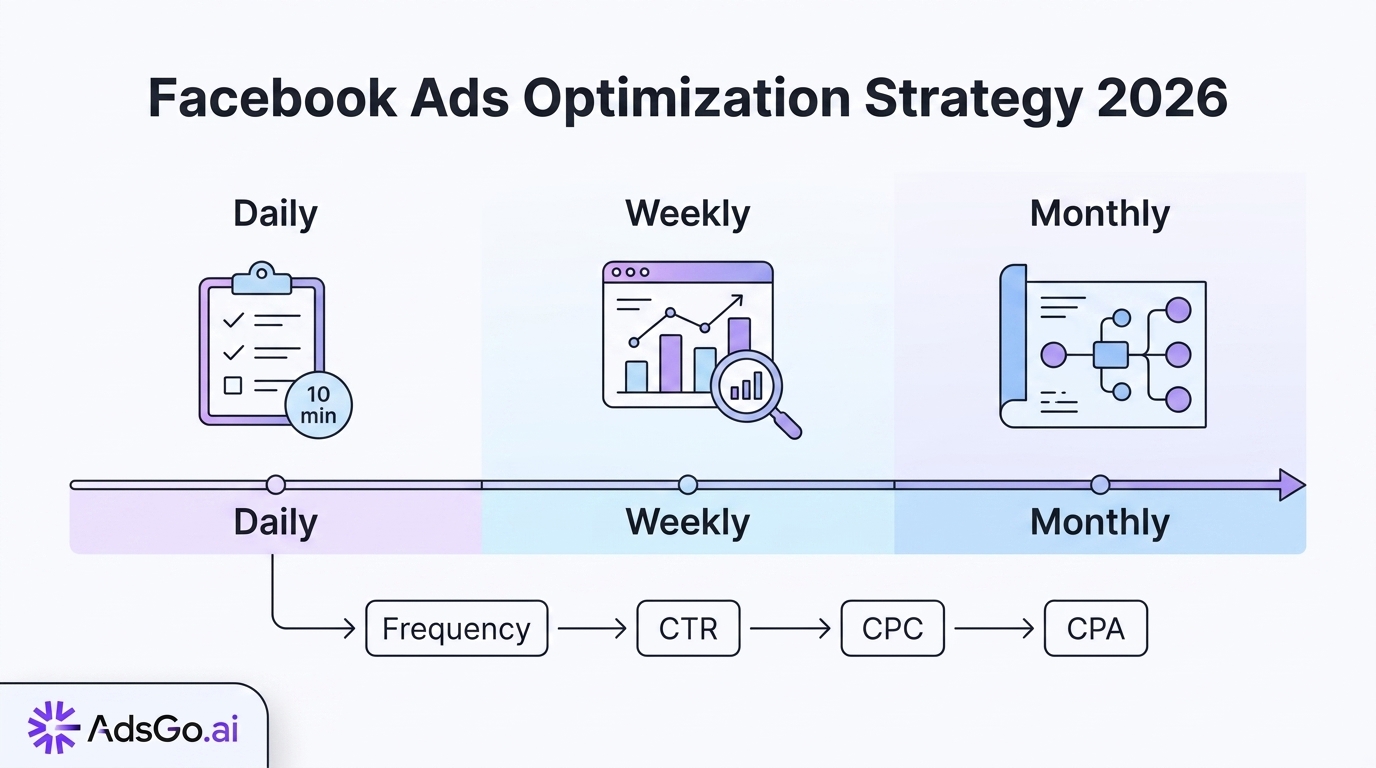
Frequency → CTR → CPC → CPA: Frequency rising causes CTR to decline, which increases CPC (since CPC = CPM ÷ (CTR × 1000)), which increases CPA. A frequency alert is a CPA alert that arrives 5–7 days early.
Audience Size → Delivery → CPM: Smaller audiences produce higher CPM as Meta must reach the same users more frequently to spend your budget. Audience expansion typically reduces CPM.
CVR → Algorithm Optimization: Lower CVR reduces Meta's Estimated Action Rate for your ads, which reduces your effective bid, which causes you to lose more auctions. A CVR decline doesn't just hurt your conversion rate — it makes your entire delivery system less efficient over 7–14 days.
Creative Quality Score → CPM: Ads receiving negative feedback (Hide, Report) receive a quality penalty that increases effective CPM even when your nominal bid hasn't changed.
ROAS inconsistent and scaling stuck?
The Daily Optimization System
What to Check Every Day (10 Minutes)
Daily checks focus on anomalies — significant deviations from your campaign's established baseline performance. Don't optimize campaigns that are performing normally. Save your intervention time for actual problems.
Check 1: Delivery status. Confirm all intended campaigns show "Active." Any "Not Delivering" or unexpected pause status requires immediate investigation.
Check 2: Yesterday's spend vs. budget. If any campaign spent less than 70% of its daily budget, flag for investigation. Common causes: audience saturation, bid pressure issue, or pacing problem.
Check 3: CPA vs. 7-day average. If yesterday's CPA is more than 30% above your 7-day average, investigate before the trend compounds. Single-day spikes can be noise; two consecutive days above +30% are a signal.
Check 4: Any campaigns in learning. Campaigns in learning should be left undisturbed unless they're also significantly underspending. Note which campaigns are in learning and their estimated exit date (based on event volume pace).
Daily Action Threshold
Take action on a metric only when:
- The deviation persists for 2+ consecutive days, OR
- The deviation is severe (CPA +50%+, spend 0% of budget), OR
- Account Quality shows a new flag or restriction
Reacting to single-day noise is one of the most common causes of learning phase resets and delivery instability.
Running daily checks manually across 10+ campaigns? AdsGo surfaces real anomalies automatically — so you spend 15 minutes reviewing decisions, not pulling data. → Try AdsGo free
The Weekly Optimization System
Weekly Review Schedule (Monday Morning, 30–45 Minutes)
Weekly optimization is where the real work happens. Review the past 7 days across all campaigns and make structural adjustments.
Creative Performance Audit
Pull CTR and CPA by creative for the past 7 days. For each creative:
Flag for replacement: CTR more than 25% below the campaign's best-performing creative, or frequency above 3.0 with declining CTR. Do not let fatiguing creatives run indefinitely — they degrade campaign-level quality scores.
Promote to primary: Creatives with CTR 20%+ above campaign average and CPA at or below target. Increase their delivery weight by pausing underperformers in the same ad set.
Launch new test: Every week, introduce at least one new creative variant that tests a different hook, format, or audience angle. This maintains creative pipeline health without requiring large-scale creative production every cycle.
Audience Performance Breakdown
Segment your 7-day CPA data by age, gender, device, and placement. Identify the two highest-CPA segments and the two lowest-CPA segments.
For high-CPA segments: evaluate whether adjusting bid (reducing via audience segment multiplier in Campaign Budget settings) or excluding the segment entirely improves blended CPA. High-CPA demographic segments are worth excluding if they consistently underperform by 40%+.
For low-CPA segments: evaluate whether creating a dedicated ad set targeting that segment with tailored creative could improve performance further.
Budget Allocation Review
Compare weekly ROAS by campaign and ad set. Shift 15–20% of budget from lowest-ROAS campaigns to highest-ROAS campaigns, provided both are above break-even ROAS. Never reduce budget on a campaign below its minimum efficient budget (the point where conversion volume drops below 30 events/week).
The Monthly Optimization System
Monthly Strategy Review (First Monday of Month, 2 Hours)
Monthly optimization focuses on campaign architecture and strategy — decisions that affect the next 30–60 days of performance.
Campaign Architecture Assessment
Review your full campaign structure:
- How many campaigns are targeting overlapping audiences? Audience overlap between ad sets inflates CPM for all of them.
- Do you have campaigns at each funnel stage (prospecting, warm retargeting, hot retargeting)? Missing stages create delivery inefficiency.
- Are all campaigns using the most current optimization events? If purchase volume has grown, campaigns that were using Add to Cart optimization should be migrated to Purchase.
Audience Saturation Analysis
Check frequency over the past 30 days for each major audience. Any audience with 30-day frequency above 8.0 is approaching exhaustion — plan to expand or replace it within 4–6 weeks.
Run Meta's Audience Overlap report for all active ad sets. Overlaps above 30% create internal auction competition that inflates CPM across all affected ad sets.
Creative Lifecycle Assessment
Categorize every active creative into: Peak (improving CTR trend), Stable (consistent CTR), Declining (CTR trending down), and Retired (CTR below threshold, should be paused). A healthy creative portfolio has 20% Peak, 60% Stable, 20% Declining, and zero Retired creatives in active delivery.
If more than 30% of your portfolio is in Declining status, creative production velocity is insufficient for your current spend level.
2026 Optimization Priorities
Three platform shifts in 2026 require updated strategy:
Advantage+ Shopping Campaigns (ASC): Meta's AI-powered campaign type now manages audience targeting, placement, and creative optimization automatically. For ecommerce accounts with strong creative libraries and sufficient conversion data (50+ weekly purchases), ASC consistently outperforms manual campaign structures. Test ASC against your best-performing manual campaign with 30% of your prospecting budget.
Broad Targeting as Primary Strategy: In 2026, Advantage+ audience signals (interest and behavioral targeting as "suggestions" rather than hard rules) outperform narrow Interest stacking for most ecommerce categories. Meta's model has improved sufficiently that providing broad targeting with strong creative inputs produces better ROAS than precise demographic filtering.
Conversions API (CAPI) Integration: iOS 14+ and browser cookie restrictions have significantly degraded browser-side Pixel accuracy. Accounts without CAPI integration are operating with 20–35% missing conversion data, which degrades algorithm optimization. Prioritize CAPI implementation if not already done.
The AI-Driven Optimization Cycle
Manual optimization — even with a structured daily/weekly/monthly schedule — is inherently reactive: something breaks, you notice it, you fix it. The cost is always paid during the gap between when performance starts slipping and when you catch it.
The shift AI enables isn't faster reaction. It's earlier detection of the metric interactions that precede problems — frequency trends that predict CTR decline days out, CVR shifts that start degrading algorithm efficiency before CPA visibly rises.
AdsGo's AI optimization system acts on those leading signals directly: rotating creative at the first sign of frequency pressure, adjusting bid weight when CVR trends shift, and expanding audience parameters before CPM spikes from saturation. The changes happen at the metric layer, not after the business metric has already moved.
AdsGo's ad insight dashboard restructures your weekly and monthly review into a pre-organized view — creative performance ranking, audience overlap flags, and budget efficiency by campaign — so the 45-minute manual process becomes a focused 15-minute decision session.
FAQ
How often should I check my Facebook ads performance?
Daily checks for anomalies (10 minutes), weekly structural reviews (30–45 minutes), and monthly strategic assessments (2 hours). More frequent checking than this leads to optimization decisions based on statistical noise rather than real signals, which creates more learning phase resets and delivery instability than it prevents.
What metrics should I optimize for in Facebook ads?
Prioritize in this order: ROAS or CPA (business outcome), then CPC and CVR (efficiency levers), then CTR and frequency (leading indicators). Optimizing for CTR alone without connecting it to CPA/ROAS often produces high-engagement, low-conversion campaigns that look good in Ads Manager but don't drive business results.
How do I know when to pause a Facebook ad?
Pause an ad when: CTR is more than 40% below the campaign's best-performing creative for 7+ days, CPA is more than 50% above target for 7+ days, or frequency is above 4.0 with no plans to refresh creative. Don't pause based on single-day performance — give any change or problem 5–7 days before concluding it's a persistent issue.
Should I run the same ads forever or keep changing them?
Changing. The average effective lifespan of a Facebook ad creative is 3–6 weeks for audiences of 500K–2M people at moderate daily spend ($50–200/day). At higher spend levels, creative fatigue arrives faster. Plan for continuous creative production rather than treating creative as a one-time investment.
Is 2026 Facebook ads optimization different from previous years?
The fundamentals haven't changed (creative quality, audience targeting, bid strategy), but three significant shifts require updated tactics: Advantage+ Shopping Campaigns outperform manual campaigns for ecommerce, broad targeting with strong creative now outperforms narrow interest targeting for most categories, and CAPI integration is no longer optional for accounts where iOS attribution matters.