
"Learning Limited" is one of the most misunderstood statuses in Facebook Ads Manager. Advertisers see it and assume their campaign is broken. Others dismiss it and let campaigns run in this state for weeks, bleeding budget into unstable delivery.
The truth is more specific: Learning Limited means your campaign is trying to learn but can't generate enough conversion data to complete that process. The algorithm is stuck in exploration mode — and exploration is the most expensive, least efficient way to run ads.
Learning Limited vs. Learning Phase
Both statuses appear in Ads Manager and both involve the learning process, but they represent very different situations.
Learning Phase (status: "Learning") is normal and expected. Every new campaign or significantly edited ad set enters a learning phase. Meta's delivery system runs experiments to identify which audiences, placements, and times generate the best results for your objective. This phase typically completes within 7 days when the ad set generates 50+ optimization events (conversions, clicks, video views — depending on your objective).
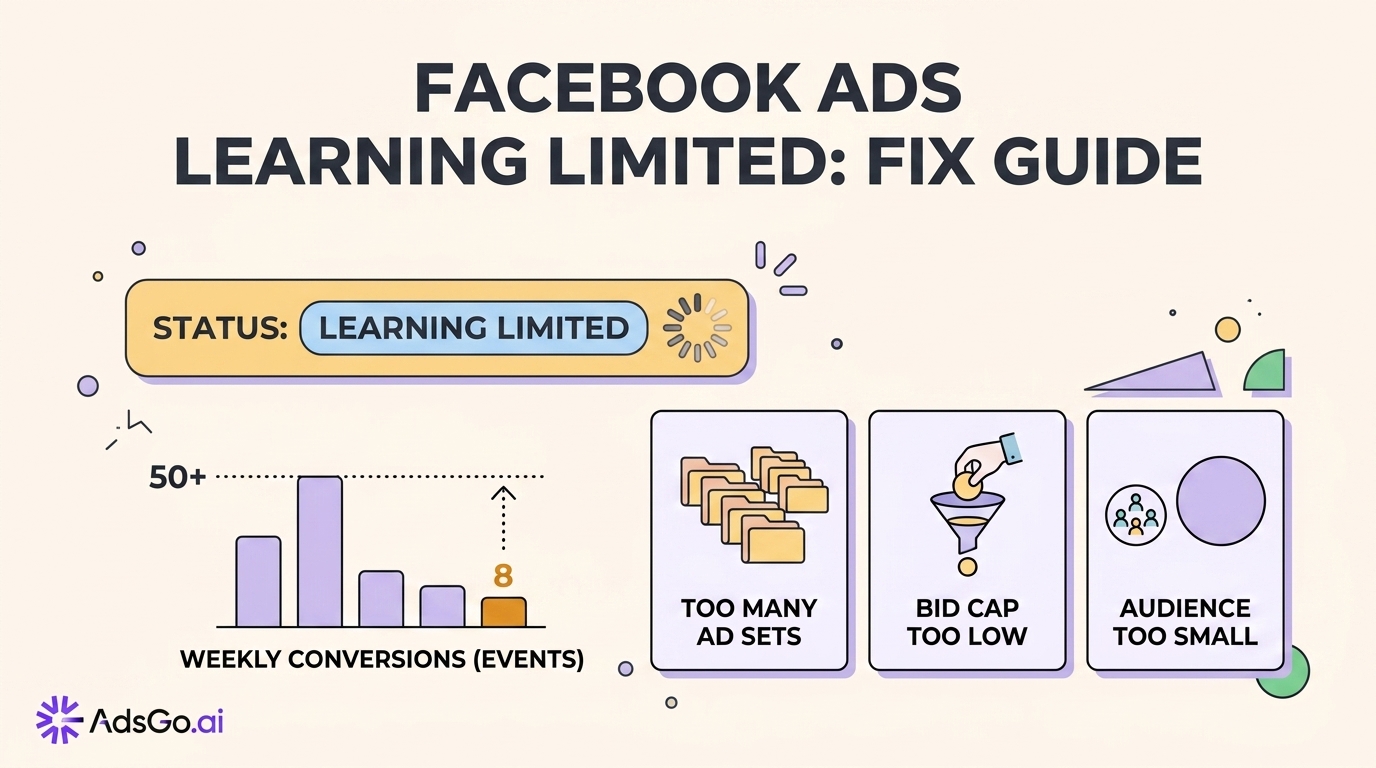
Learning Limited is a failure state. It means your campaign has been running long enough that it should have exited learning, but the system couldn't gather sufficient data to stabilize delivery. The campaign will show this status indefinitely without intervention.
The functional consequence: an ad set in Learning Limited will deliver inconsistently (heavy spend one day, near-zero the next), cannot be optimized effectively by the algorithm, and will underperform compared to a fully exited campaign by 20–35% on CPA in most cases. (industry estimate)
Stuck in Meta’s learning phase with no clear exit?
The 50-events threshold
Meta's algorithm generally needs approximately 50 optimization events per ad set per week to exit the learning phase. This is an observed threshold, not a hard rule — the actual requirement varies by account history, audience quality, and campaign objective.
With fewer than 50 events, the system can't determine with sufficient confidence which audience segments, placements, or creative variants drive results. The delivery model remains unstable, which is why Learning Limited campaigns show erratic spend patterns.
The 50-event threshold applies to your chosen optimization event. If you're optimizing for Purchases and getting 8 purchases per week, you're well below what the algorithm typically needs. As a rough guide: if your CPA is $40 and you're targeting 50 purchases per week, you'd need approximately $2,000/week (about $286/day) — though actual learning speed also depends on audience competition, creative performance, and account history.
This is why campaigns with small budgets relative to CPA often stay stuck in Learning Limited — the data volume simply isn't there, regardless of how well the campaign is structured.
Optimization Event Hierarchy
If your primary conversion event can't hit 50 events per week, Meta's solution is to move up the funnel to a higher-volume event:
| Optimization Event | Typical Weekly Volume at $100/day |
|---|---|
| Purchase | 3–15 events |
| Add to Cart | 15–60 events |
| View Content | 50–200 events |
| Link Click | 200–1,000 events |
Moving from Purchase to Add to Cart optimization increases event volume 3–5×, making it far easier to exit learning. The trade-off: you're optimizing for a weaker signal, so conversion quality may decrease. Test this approach if your purchase volume is under 30/week.
3 reasons campaigns stay limited
Too Many Ad Sets Splitting Budget
Each ad set needs 50 events per week to exit learning independently. If you have 6 ad sets in one campaign sharing a $300/day CBO budget, each ad set gets roughly $50/day on average. At a $30 CPA, that's about 1–2 purchases per ad set per day — far below the 7/day needed for weekly exit.
Consolidating 6 ad sets into 2 gives each ad set $150/day, generating 5 purchases per day per ad set — still not perfect, but dramatically closer to the threshold.
Fix: Consolidate to the minimum number of ad sets that meaningfully test different audiences. For most accounts, 2–4 ad sets per campaign is the sweet spot for learning efficiency.
Bid Cap Set Below the Learning Floor
When you set a bid cap (maximum CPA you're willing to pay), Meta's system can only bid up to that ceiling. If the bid cap is set too low, Meta either loses most auctions (resulting in low volume) or simply can't find enough users willing to convert at that cost.
A bid cap of $15 in a market where the realistic CPA is $30 means you win maybe 20% of the auctions you'd otherwise win — cutting your conversion volume by 80%. Learning Limited often follows.
Fix: During the learning phase, remove all bid caps. Once the campaign exits learning with stable CPA data, you can reintroduce cost controls based on real performance data rather than estimates.
Audience Too Restrictive for Data Collection
A highly targeted audience of 80,000 people may be a great long-term remarketing audience, but it's insufficient for learning. Meta needs enough population density to run its learning experiments across different sub-segments. Very small audiences don't provide enough diversity for the algorithm to learn from.
Audiences under 200,000 are at risk of producing Learning Limited status even with appropriate budgets.
Fix: For the learning phase specifically, start with broader audiences (1M+). Once the campaign stabilizes and exits learning, you can create more targeted ad sets within the same campaign to reach niche segments while keeping the broader targeting as a traffic baseline.
Campaigns stuck in Learning Limited with no clear fix? AdsGo flags the exact constraint — budget floor, bid cap, or ad set fragmentation — before it costs you a full week. → Try AdsGo free
How to Accelerate Learning Phase Exit
Structural Optimization (Most Impactful)
Three structural changes that most reliably accelerate learning exit:
Raise the optimization event level. Move from Purchase to Add to Cart or Initiate Checkout to increase event volume 3–5× without touching your budget.
Raise daily budget above the learning floor. A rough heuristic: target CPA × 7 ≈ minimum daily budget per ad set. For a $40 CPA, that's around $280/day — enough to generate ~7 purchases daily, which is the approximate floor for a consistent weekly exit. Real requirements vary.
Eliminate non-essential ad set splits. Overlapping ad sets split conversion data and compete against each other in auction — consolidate first, optimize second.
Creative Consolidation
More creative variants slow learning — each variant splits the ad set's conversion data allocation. During the learning phase, limit each ad set to 3–5 creatives maximum. Expand variants only after the campaign exits learning with stable delivery.
How AdsGo Manages the Learning Phase Automatically
Manually monitoring learning status, event volumes, and deciding when to intervene requires checking multiple dashboards several times per day. For accounts with 10+ active campaigns, this is operationally unsustainable.
AdsGo's AI optimization system tracks learning phase status across all Meta campaigns in real time. When an ad set approaches day 5 without sufficient event volume to project a clean exit, AdsGo surfaces a specific recommendation — whether that's increasing the budget, switching optimization events, or consolidating ad sets — before the campaign gets stuck in Learning Limited status.
For campaigns already in Learning Limited, AdsGo identifies the exact structural constraint (budget floor, bid cap conflict, or ad set fragmentation) causing the stall and provides the specific parameter adjustments needed to break out.
FAQ
How long does the Facebook Ads learning phase last?
The learning phase typically lasts 7–14 days. It ends when your ad set accumulates 50 optimization events (the type depends on your objective). If 7 days pass without reaching 50 events, the status changes to Learning Limited. Making significant edits to the ad set resets the learning phase from zero.
Does editing my campaign reset the learning phase?
Yes — significant edits reset learning. This includes changes to audience targeting, bid strategy, optimization event, creative, and budget increases over 30%. Minor edits (updating URL parameters, changing the ad name, small creative text edits) do not reset learning. Avoid edits during the learning phase unless absolutely necessary.
Can I just ignore Learning Limited status?
You can, but the cost is real. Learning Limited campaigns consistently underperform stabilized campaigns on CPA by 20–35% (industry estimate). The erratic delivery also makes it difficult to measure true performance, since a 3× spend day followed by a $0 day averages out to misleading results.
What if my budget can't support 50 conversions per week?
Switch your optimization event to something higher in the funnel — Add to Cart, View Content, or even Landing Page View. You'll be optimizing for a weaker conversion signal, but you'll exit learning reliably. Once your account matures and conversion volume increases, you can gradually move the optimization event back down to Purchase.
Why does my campaign keep going back into learning after it exits?
Campaigns re-enter learning after any significant edit. Common triggers: changing bid strategy, adjusting audience size by more than 30%, switching creative, or Meta's periodic re-optimization cycles that occur when performance trends shift significantly. To minimize re-entries, batch edits and avoid touching actively performing campaigns unless necessary.