
Ads Manager shows 2.1x ROAS. Finance says Facebook ads ROI is negative after COGS and returns. You are about to cut prospecting budget — but you are not sure whether Meta is under-reporting sales or your margin model is finally catching up to ad spend.
Low Facebook ads ROI is a profitability problem, not a dashboard aesthetic problem. In 2026, many accounts look worse in-platform while total revenue holds steady — attribution changes, deduplication gaps, and MER blind spots all masquerade as "bad ads."
In this guide, you will separate reported ROI from real business ROI, run the ROI Reality Check (RRC), and fix causes in dependency order so you do not optimize on phantom drops.
What Low Facebook Ads ROI Means
Facebook ads ROI is low when profit after ad spend, COGS, and returns stays below target for 7+ days at real spend. It is not the same as low ROAS: Ads Manager can show healthy revenue multiples while the channel loses money after margins. Fix starts by checking whether the drop is reported, real, or a prospecting economics problem.
ROI measures whether Meta earns profit after all costs; ROAS only compares attributed revenue to ad spend inside Ads Manager. A 3.0x ROAS campaign can still destroy ROI if average order value is thin, return rates are high, or you are rebuying existing customers at full prospecting CPM.
Three ROI Readings Advertisers Mix Up
| Reading | Formula (simplified) | What it tells you |
|---|---|---|
| Platform ROAS | Revenue ÷ ad spend (Ads Manager) | Auction efficiency signal |
| MER | Total business revenue ÷ total ad spend | Channel sanity check |
| True ROI | (Contribution profit − ad spend) ÷ ad spend | Whether Meta pays for itself |
If MER is stable but platform ROAS fell 25%, you likely have a reporting or attribution issue — not a broken offer. If MER and cash collection both fell, you have a real performance problem worth structural fixes.
For ROAS mechanics and benchmarks, see what ROAS means in Facebook advertising. For lever-by-lever ROAS recovery, see how to improve Facebook Ads ROAS.
ROI down but revenue feels stable?
Why Facebook Ads ROI Drops
ROI falls when any layer between click and retained profit breaks. Competitors cluster fixes around creative and bidding; the layers below explain why those fixes fail when the wrong layer is broken.
Layer 1: Reporting and Attribution
Meta's 2026 attribution is more conservative than many advertisers expect. Click-through paths count fewer assisted touches; Pixel-only setups still miss a meaningful share of iOS and in-app events without Conversions API (CAPI) (Source: Meta Business Help, 2025).
Symptoms of a reporting-led "low ROI" scare:
- Ads Manager purchases down 15–30% while Shopify/ERP revenue is flat
- Event Match Quality below 6.0 on Purchase
- Sudden ROAS drop right after an attribution window change
Fix direction: CAPI + deduplicated event_id, then compare MER — not just Ads Manager — for two weeks before cutting spend.
Layer 2: Unit Economics and Offer
Real ROI drops when customer acquisition cost (CAC) rises faster than contribution margin. Common drivers:
- Prospecting CPM up 20–40% with flat conversion rate (Source: WordStream Facebook benchmarks, 2025)
- Discount-heavy creative attracting low-LTV buyers
- Returns and shipping eating margin on Meta-acquired orders
Symptoms:
- MER down in parallel with Ads Manager
- New customer share falling while retargeting ROAS looks strong
- AOV down 10%+ on Meta-sourced orders
Layer 3: Delivery and Creative Stress
Creative fatigue and audience overlap inflate CPM and depress conversion rate — which drags both ROAS and true ROI. Frequency above 3.5 on cold campaigns for seven days often precedes CPA spikes by 5–7 days.
Symptoms:
- CTR down 20%+ vs best creative with rising frequency
- Overlapping custom audiences without exclusions
- Learning Limited on Purchase optimization at low daily budgets
Link to why Facebook ads are not converting when clicks exist but purchases stall. Run Facebook ads audit before scaling spend 20%+.
The ROI Reality Check
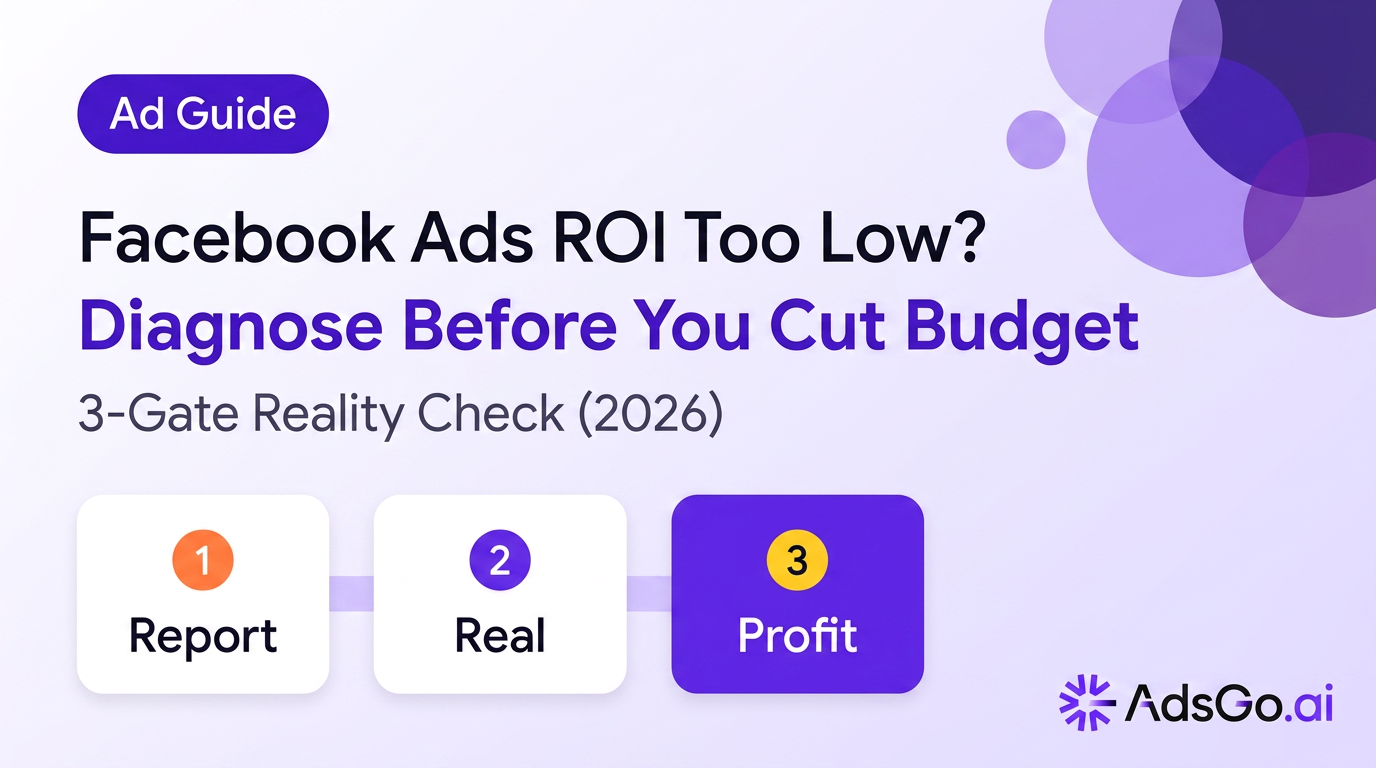
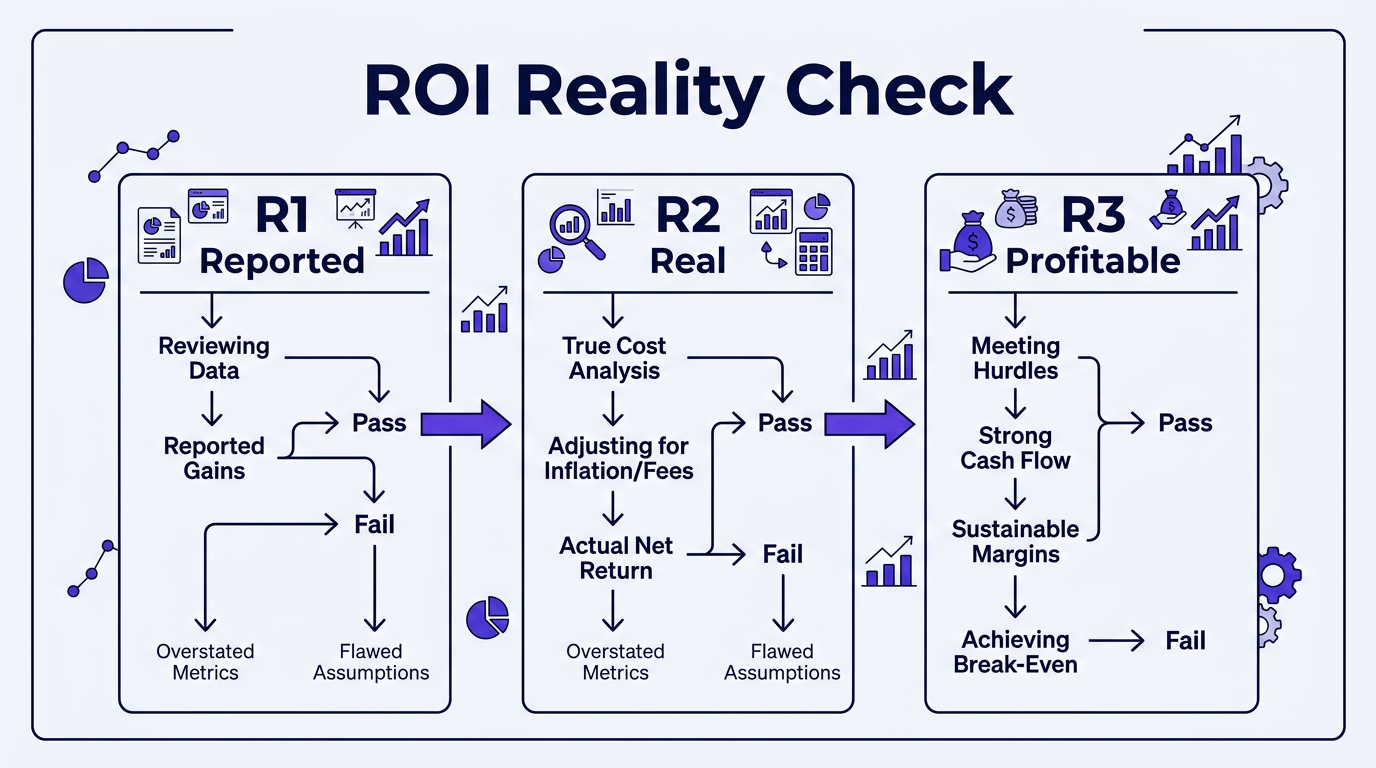
The ROI Reality Check (RRC) is a three-gate diagnostic you run before changing structure, creative, or bids. Each gate answers one question: is the drop reported, real, or unprofitable at your margin?
| Gate | Question | Pass signal | Fail → next action |
|---|---|---|---|
| R1 — Reported | Is Ads Manager under-counting? | MER within 10% of 90-day baseline | Fix Pixel/CAPI (#1) |
| R2 — Real | Did contribution profit fall? | MER down ≥15% vs prior 28 days | Fix offer/AOV/returns (#2) |
| R3 — Profitable | Is prospecting ROI positive? | New-customer contribution margin > CAC | Fix creative/funnel (#3) |
Run gates in order. Passing R1 but failing R2 means cutting budget will shrink revenue without fixing margin. Failing R3 while R1–R2 pass often means retargeting is masking weak cold acquisition.
R1 Checklist: Reporting Integrity
- Purchase events in last 48 hours with EMQ ≥ 6.0
- Pixel + CAPI share
event_idon paired events - Compare 7-day Ads Manager revenue to backend orders (same SKU set)
- Document attribution window — note any change date
R2 Checklist: Economics
- Calculate contribution margin per order (price − COGS − shipping − payment fees)
- Split new vs returning customers in backend — not in Ads Manager alone
- Track return rate on Meta-acquired cohorts for 30 days
R3 Checklist: Delivery Health
- Cold campaign frequency, CTR, CPM vs 14-day best
- Audience overlap test (Audiences → overlap tool)
- Learning status on primary Purchase ad sets
Fix ROI in Priority Order
After RRC, apply fixes in this sequence. Skipping ahead resets learning without moving profit.
P0 — Restore Trustworthy Signal (24–72 hours)
Implement or repair CAPI. Pass hashed email/phone where allowed. Remove duplicate Pixel fires. Do not change audiences or budgets during the first 72 hours after a tracking repair — let Purchase volume restabilize.
Quick MER sanity template (weekly):
MER = Total store revenue (all channels) ÷ Total paid media spend (Meta + others)
Platform ROAS = Meta-attributed revenue ÷ Meta spend only
When MER ÷ Meta ROAS is above 1.15 for two consecutive weeks, treat Ads Manager as under-reporting until P0 is complete. Finance should use MER for budget decisions; media buyers use platform ROAS for creative and auction tuning inside Meta.
P1 — Align Economics (3–7 days)
If R2 failed: tighten prospecting offer to contribution-positive AOV, add bundles to lift margin, or exclude low-margin SKUs from catalog campaigns. Raise prices before slashing spend if MER is down and margin is the bottleneck.
P2 — Rebuild Efficient Delivery (5–10 days)
If R3 failed: pause fatigued creatives, launch one new concept (new hook, not color swap), consolidate ad sets so each can reach ~50 weekly optimization events. Cap cold frequency around 2–3 per week when pools are small.
Benchmark guardrails while fixing delivery:
| Metric | Cold prospecting watchpoint | Action if breached |
|---|---|---|
| Feed CTR | Below 0.8% for 7 days | New hook + format test |
| Frequency | Above 3.5 in 7 days | Refresh creative or shrink pool |
| LPV rate | Below 70% of link clicks | Page speed + message match |
These thresholds align with common Meta prospecting benchmarks (Source: WordStream Facebook benchmarks, 2025) — adjust for your category if historical data differs.
P3 — Rebalance Funnel Spend (7–14 days)
Retargeting-heavy accounts show strong platform ROAS but weak new-customer ROI. Shift 10–15% of budget from BOF to TOF only after P0–P2 pass — see Facebook ads funnel strategy for stage splits.
What Low ROI Costs You
| Scenario | Daily Meta spend | Estimated monthly profit leak* |
|---|---|---|
| Reporting gap only | $200/day | $0–$1,200 (opportunity cost of wrong cuts) |
| 20% CVR drop, flat CPM | $300/day | $3,600–$5,400 |
| CPM +25%, flat CVR | $500/day | $7,500–$11,000 |
*Illustrative ranges for DTC accounts with 40–55% contribution margin; validate against your MER and finance data.
The expensive mistake in 2026 is pausing prospecting because Ads Manager ROI dipped while MER held — then losing new customer volume for 30–45 days. The second mistake is scaling a 2.5x ROAS retargeting pool while cold acquisition loses money on every order.
Prevention: Weekly ROI Rhythm
Run a 20-minute Friday review so low Facebook ads ROI does not surprise you at month close:
- Export MER and Meta spend from the same 7-day window
- Note any attribution window or AEM priority change in Events Manager
- Flag ad sets where frequency rose while CTR fell (leading indicator)
- Log one planned creative test for next week — not five simultaneous edits
Accounts that document change dates recover faster after platform updates because they can separate reporting noise from real margin compression.
How AdsGo Spots Real Drops
Teams often discover low Facebook ads ROI only after finance closes the month — when Ads Manager still looked acceptable week to week.
AdsGo AI Optimization tracks performance trends against your optimization events and flags when reported efficiency diverges from spend patterns that usually precede real MER declines — frequency/CTR stress, event mismatch, or consolidation needs — before you cut prospecting based on a single ROAS column.
Pair platform alerts with a weekly MER sheet: total revenue ÷ total paid spend across Meta and other channels. When MER and Ads Manager move together, treat it as a real ROI problem and run P1–P3. When they diverge, finish P0 first.
FAQ
What is a good ROI for Facebook ads?
There is no universal percentage — it depends on contribution margin and payback window. Ecommerce brands often target positive contribution profit within 30–60 days on cold acquisition; subscription brands may accept longer payback. Use MER plus cohort margin, not platform ROAS alone.
Why is my Facebook ads ROI low but ROAS looks fine?
ROAS ignores COGS, returns, and whether sales are new vs repeat. Retargeting-heavy accounts commonly show 2.5–4.0x ROAS while prospecting loses money. Split performance by customer type in your backend before judging channel ROI.
How is Facebook ads ROI different from ROAS?
ROAS is revenue divided by ad spend inside Meta. ROI is profit return after costs relative to spend. You can improve ROAS by discounting — and still lower true ROI if margin collapses.
Can attribution changes alone lower Facebook ads ROI?
Reported ROI/ROAS can drop 15–30% when attribution windows tighten or events are under-counted, even when bank deposits are stable. Run RRC Gate R1 and compare MER before structural changes.
How long should I wait before deciding ROI is truly low?
Use 7 days minimum at $50–200/day, or until you have 100+ link clicks on the ad set you are judging. Single-day moves are noise. After tracking fixes, wait 72 hours before re-evaluating Purchase optimization.
Should I cut budget when Facebook ads ROI is low?
Cut only after RRC: if MER is down ≥15% and contribution margin on new customers is negative. If MER is stable, fix tracking and creative — do not cut prospecting solely on Ads Manager ROAS.