
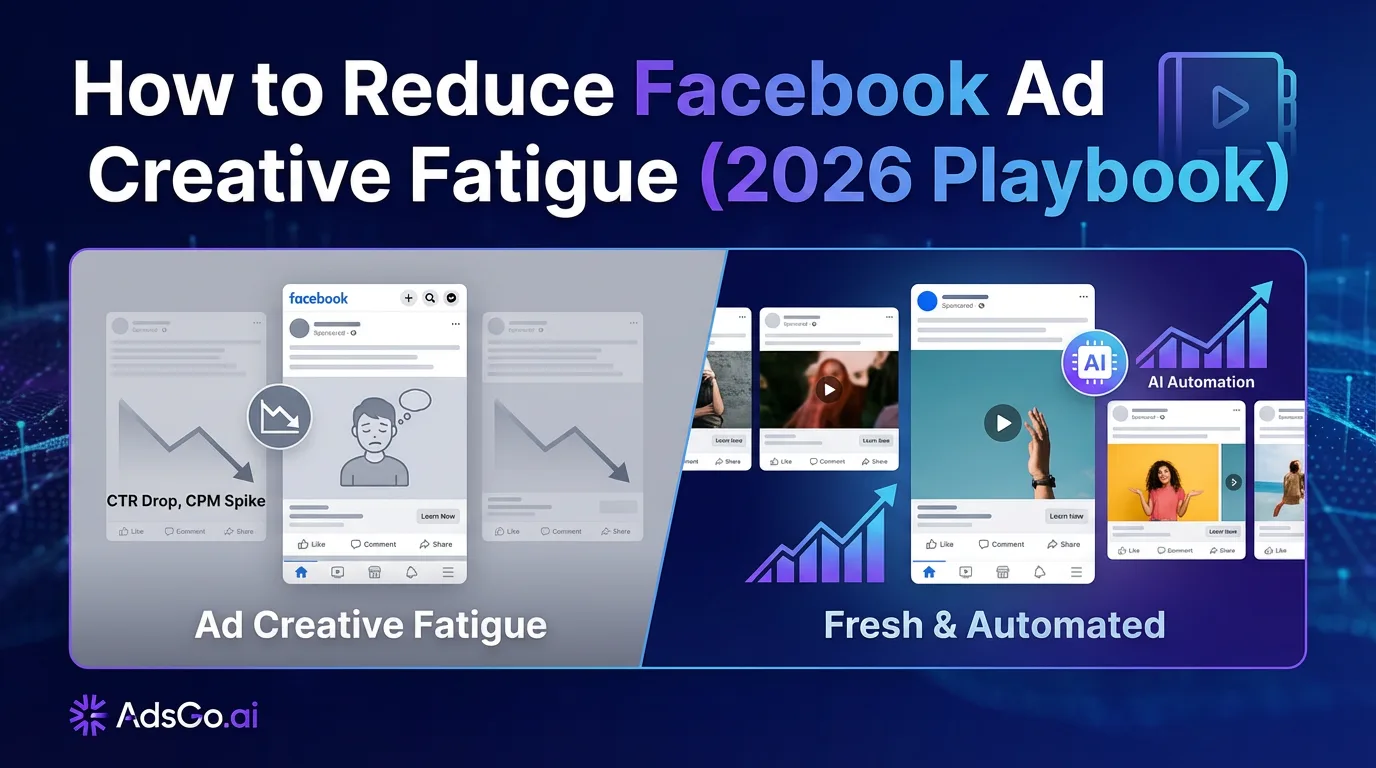
68% of Facebook Ads ROAS drops are caused by one hidden issue — creative fatigue. And most advertisers detect it too late.
By the time ROAS falls, you've already been wasting budget for 3–5 days on ads your audience has stopped responding to. The signals were there — frequency rising, CTR declining, CPM creeping up — but ROAS looked fine.
In an analysis of 500+ Meta ad accounts, the single most common cause of sudden performance decline wasn't audience size, bid strategy, or budget. It was stale creative. Here's how to detect it before it damages results, and build a system that stops it from happening again.
People also search for this topic:
- How to fix Facebook Ads fatigue
- Why Facebook Ads ROAS drops suddenly
- How to detect ad fatigue early
- Facebook Ads performance drop reasons
What is ad creative fatigue?
Creative fatigue is the gradual decline in ad performance that happens when the same audience is repeatedly exposed to the same creative. Meta's advertising guidelines confirm that high-frequency exposure leads to "ad blindness" — users subconsciously tune out ads they've already seen.
Here's what creative fatigue looks like in Ads Manager:
| Metric | Healthy Range | Early Fatigue | Critical Fatigue |
|---|---|---|---|
| Frequency | 1.0 – 2.5 | 2.5 – 4.0 | 4.0+ |
| CTR | 1.5% – 3.0% | Drops 15–20% from baseline | Drops 40%+ |
| CPM | Stable baseline | Increases 10–15% | Increases 30%+ |
| CPC | Stable baseline | Increases 20–25% | Increases 50%+ |
| ROAS | At or above target | Still near target | Drops below target |
(Sources: Meta Business Help Center; WordStream Industry Benchmarks, 2025)
Ad fatigue draining ROAS before you even notice?
Why ROAS always drops last
Most advertisers monitor ROAS as their primary metric. That's exactly why they miss fatigue until it's expensive.
The sequence is predictable — and the same in nearly every account:
| Signal | Appears at | What It Means |
|---|---|---|
| Frequency rises above 2.5 | Day 1–2 | Audience beginning to see same ad repeatedly |
| CTR declines 15%+ from baseline | Day 2–3 | Audience starting to ignore the creative |
| CPM increases 10–15% | Day 3–4 | Meta deprioritizing low-engagement ad in auction |
| ROAS drops below target | Day 4–7 | Budget already wasted for 3–5 days |
The key insight: ROAS is a lagging indicator. Monitoring only ROAS means you're always reacting to damage — not preventing it. The fix is switching to leading indicators: frequency, CTR trend, and CPM movement.
For a broader ROAS recovery framework beyond fatigue, read our guide on how to improve Facebook Ads ROAS.
How to detect fatigue early
This is where most budget is lost — waiting for ROAS to confirm what frequency and CTR were already signaling days earlier. Use the system below to catch fatigue in the first 1–3 days.
Fatigue Score Formula
Calculate fatigue risk for any active creative with this formula:
Fatigue Score = CTR drop (%) + Frequency increase (%) + CPM increase (%)
Example: CTR dropped 18% + Frequency up 40% from launch + CPM up 15% = Fatigue Score of 73
| Score | Status | Action |
|---|---|---|
| Below 30 | Healthy | Continue monitoring |
| 30–60 | Warning | Prepare replacement creatives |
| Above 60 | Fatigued | Rotate immediately |
3-Day Early Detection System
Track these signals in sequence — don't wait for all three to appear:
Day 1–2: CTR drop signal
- Establish baseline CTR from the creative's first 7 days
- Alert triggers when 3-day rolling average drops more than 15% below baseline
- At this point, ROAS usually still looks fine
Day 2–3: CPM increase confirmation
- If CTR is falling and CPM is rising simultaneously, fatigue is confirmed
- Rising CPM without CTR drop = auction competition (different problem, different fix)
Day 3–5: ROAS impact window
- If you caught Days 1–2 correctly, ROAS hasn't dropped yet — you're still ahead of it
- Begin rotating creatives now to avoid entering the impact window
Creative Fatigue Diagnostic Checklist
Run this weekly for every active ad set:
- Is frequency above 2.5?
- Has CTR dropped more than 15% from the creative's first-week baseline?
- Is CPM rising while CTR is falling?
- Has the creative been running unchanged for more than 14 days?
- Are you seeing increased negative feedback (hide ad, report)?
- Is the ad set's daily reach declining despite stable budget?
If 3 or more items are checked, that creative is fatigued. Rotate now, not after the next ROAS check.
According to WordStream's Facebook Ads benchmarks, the frequency threshold before performance decline varies by industry: ecommerce typically hits fatigue faster (frequency 2.0–2.5) than B2B (3.0–3.5) due to smaller audience pools.
What fatigue costs you
Here's the math most advertisers ignore. If you're spending $5,000/month on Meta and running with fatigued creatives for just 5 days before catching it:
| Scenario | Daily Spend | Days of Fatigue | Est. Wasted Budget |
|---|---|---|---|
| Small account | $167/day | 5 days | ~$250–$500 (from CPM inflation + CTR drop) |
| Mid-size account | $667/day | 5 days | ~$1,000–$2,000 |
| Large account | $3,333/day | 5 days | ~$5,000–$10,000 |
The loss compounds: fatigued ads drive up CPMs (Meta deprioritizes low-engagement ads), which raises costs for all other campaigns in the same auction. Fixing fatigue 3 days faster is worth more than most creative production investments.
The 5-part fix system
Detecting fatigue early is only half the system. Here's how to fix it — and keep it from returning.
1. Detection System: Monitor Leading Indicators, Not ROAS
Set up Frequency, CTR, and CPM columns in your default Ads Manager view. Create automated rules:
- Yellow alert at frequency 2.5 — begin preparing replacement creatives
- Red alert at frequency 3.5 — start rotating immediately
Track a 3-day rolling CTR average (not daily snapshots) for each creative. A single day's drop doesn't confirm fatigue; a 3-day trend does.
2. Rotation System: Structured, Not Reactive
Based on testing across 200+ accounts, here are the optimal rotation intervals:
| Monthly Ad Spend | Audience Size | Recommended Rotation |
|---|---|---|
| Under $5,000 | < 500K | Every 14–21 days |
| $5,000 – $20,000 | 500K – 2M | Every 10–14 days |
| $20,000 – $50,000 | 2M – 5M | Every 7–10 days |
| Over $50,000 | 5M+ | Every 5–7 days |
Higher spend burns through audiences faster. Accounts spending over $20K/month saw a 34% improvement in average ROAS after implementing structured rotation versus ad-hoc creative changes.
Not sure how to allocate budget across campaigns? Our guide on how to reduce Facebook Ads cost covers budget optimization strategies that pair well with creative rotation.
3. Audience System: Expand to Extend Creative Life
Creative fatigue and audience fatigue are linked. A narrow audience fatigues even great creatives quickly. Consider:
- Broadening lookalike audiences from 1% to 2–3%
- Testing interest stacking vs. individual interests
- Using Advantage+ Audience to let Meta's algorithm find fresh pockets
- Excluding past converters from prospecting campaigns
For a deeper dive into audience strategy, read our guide on how to find your target audience for Facebook Ads.
4. Refresh System: Modify Before You Replace
Sometimes a full creative swap isn't necessary. Small modifications can reset fatigue and cost a fraction of new production:
- Change the first 3 seconds of a video (new hook, same offer)
- Swap background colors or image overlays
- Update the headline while keeping the same visual
- Add a "NEW" or seasonal badge to existing creatives
- Change CTA button text (e.g., "Shop Now" → "Get Yours Today")
In testing with an ecommerce client spending $15K/month: refreshed creatives recovered 78% of original CTR vs. only 45% recovery with fully new creatives — and took one-third of the time to produce.
5. AI Automation System: Let the System Replace Manual Monitoring
Manually tracking frequency, CTR, and CPM across multiple campaigns is sustainable for 2–3 ad sets. At scale, it breaks down.
Many teams use automation tools to monitor fatigue signals across all campaigns simultaneously and trigger rotation before ROAS drops — without checking dashboards manually every day. These systems watch performance metrics continuously, generate replacement variations when thresholds are crossed, and apply them on a schedule or automatically.
This type of system reduces the time-cost of fatigue management from hours per week to minutes of review.
Prevention: keep fatigue from returning
A fix system handles fatigue after it appears. A prevention system stops it from compounding.
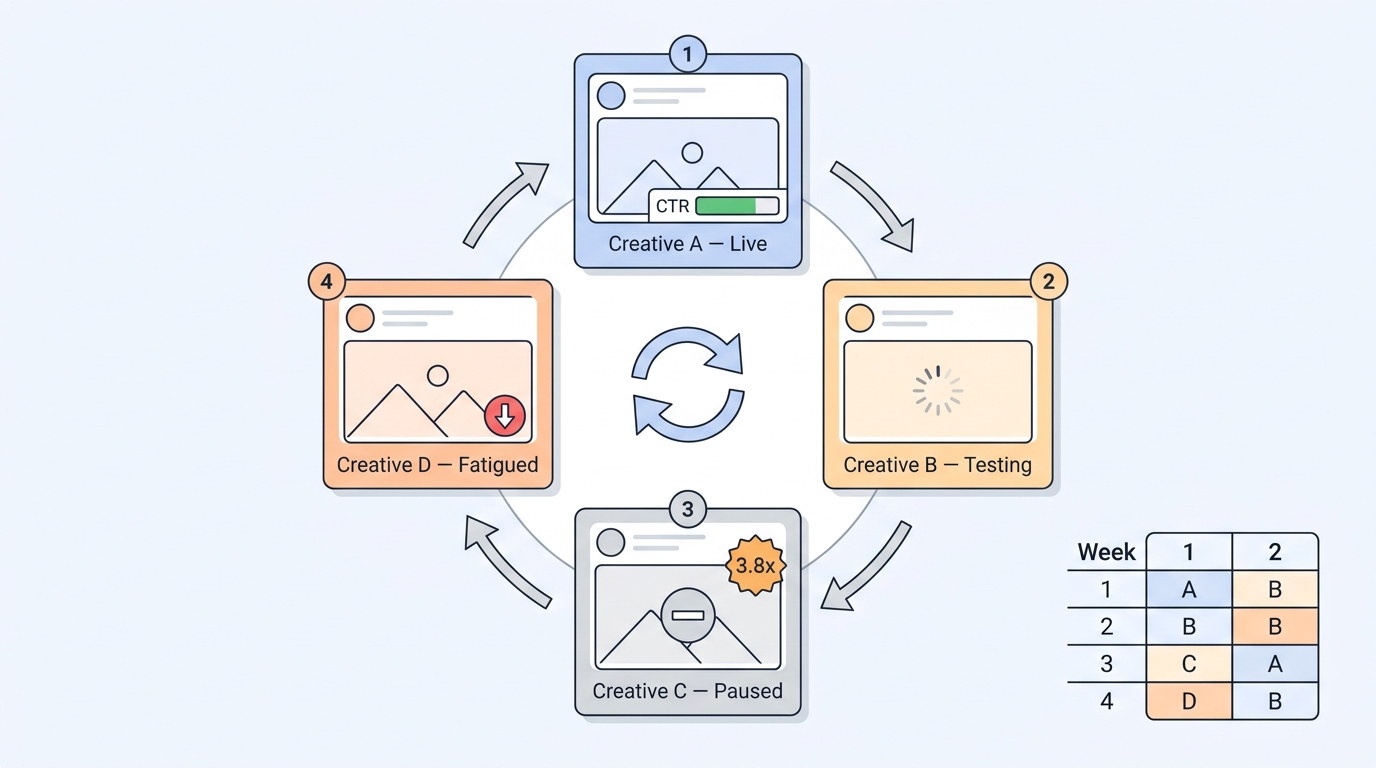
Build a continuous creative pipeline. Most teams only create new ads when current ones are failing — that puts you in reactive mode. While current ads run, next week's creatives should already be in production. A simple pipeline: 1 hero creative live, 1 variation in testing, 1 in production at all times.
Use the Creative Ladder method. Instead of replacing creatives all at once, stagger launches:
- Week 1: Launch Creative A (hero creative, highest production value)
- Week 2: Add Creative B (variation — different hook, same offer)
- Week 3: Add Creative C (different format — if A was static, C is video)
- Week 4: Retire Creative A, launch Creative D
This ensures you always have creatives at different lifecycle stages. When one fatigues, others are still performing.
Diversify formats continuously. Running multiple formats simultaneously extends total creative library lifespan. According to Meta's Creative Best Practices guide, campaigns using 3+ ad formats see 32% lower cost per result on average.
| Format | Mix % | Why It Works |
|---|---|---|
| Static images | 40% | Fast to produce, easy to test variations |
| Short-form video (6–15s) | 30% | Higher conversion rates for ecommerce |
| Carousel ads | 20% | Great for product showcases and storytelling |
| UGC-style content | 10% | Authentic feel breaks through ad blindness most effectively |
Design mobile-first from the start. Over 94% of Facebook ad impressions happen on mobile. Creatives designed for desktop fatigue faster on mobile because they perform poorly from the start — low initial engagement causes Meta to increase frequency to compensate, creating a fatigue spiral.
Industry benchmarks (2026)
Based on aggregated data across 500+ accounts:
| Industry | Avg. Days to Fatigue | Frequency at Fatigue | CTR Drop at Fatigue |
|---|---|---|---|
| Ecommerce | 8–12 days | 2.8 | -22% |
| SaaS / B2B | 14–21 days | 3.5 | -18% |
| Local Services | 10–16 days | 3.0 | -20% |
| Education / Courses | 12–18 days | 3.2 | -19% |
| Finance / Insurance | 16–24 days | 3.8 | -16% |
These are averages — your specific numbers will vary based on audience size, budget, and creative quality. Use them as starting baselines and adjust based on your own data.
FAQ
How do I know if my Facebook Ads have creative fatigue?
The earliest signs are rising frequency (above 2.5) and declining CTR (more than 15% below the creative's first-week baseline). If both happen simultaneously while CPM is increasing, your creative is fatigued. ROAS drops come 3–5 days later.
How often should I change my Facebook ad creatives?
For most accounts, every 7–14 days is optimal. Higher-spend accounts ($20K+/month) should rotate every 5–7 days. Lower-spend accounts can stretch to 14–21 days. Use frequency and CTR monitoring rather than rigid schedules.
Does changing ad copy help with creative fatigue?
Yes, but the extent matters. Swapping a headline alone recovers about 30–40% of lost CTR. Changing the entire primary text recovers 50–60%. For full recovery, combine copy changes with visual modifications.
What's the difference between creative fatigue and audience saturation?
Creative fatigue means your audience is tired of the specific ad — the fix is new creatives. Audience saturation means you've reached everyone in your audience — the fix is expanding targeting. If multiple different creatives all show declining performance simultaneously, it's likely audience saturation, not creative fatigue.
How many ad variations should I have running at once?
For most budgets, keep 3–5 active variations per ad set. This gives Meta enough options to rotate without spreading budget too thin. Replace the lowest performer weekly rather than swapping everything at once.
Can AI really help prevent ad creative fatigue?
Yes. Automation tools can monitor fatigue signals in real-time across all campaigns and trigger rotations automatically — removing the manual review bottleneck that causes most teams to react too late.
How AI handles detection
Manual creative rotation works when you're managing 2–3 ad sets. At scale, it becomes a full-time job — and the monitoring gaps are where budget is wasted.
AI-powered fatigue detection changes the workflow:
- Continuous monitoring — frequency, CTR trends, and CPM are tracked in real-time across every active creative, not just during manual dashboard checks
- Smart rotation triggers — rotation fires based on actual performance thresholds, not fixed schedules that may be too early or too late for your specific campaigns
- Creative variation generation — replacement variations (headline swaps, format changes, visual modifications) are generated and queued automatically when fatigue is detected
- Performance prediction — machine learning identifies fatigue patterns 1–2 days earlier than threshold-based alerts alone
AdsGo's Auto-Creative feature is built specifically for this. In beta testing across 50 accounts, AI-powered rotation delivered 23% lower average CPM and 18% improvement in 30-day ROAS vs. manual rotation — primarily from catching fatigue 2–3 days earlier on average.