
You checked Ads Manager this morning. Same audience. Same creative. But your cost per result jumped 40% overnight.
You didn't change a thing — yet you're paying more and getting less. And Facebook won't tell you exactly why.
Here's what's actually happening, and here's how to fix it.
Why Facebook Ads Cost So Much (The Auction Nobody Explains)
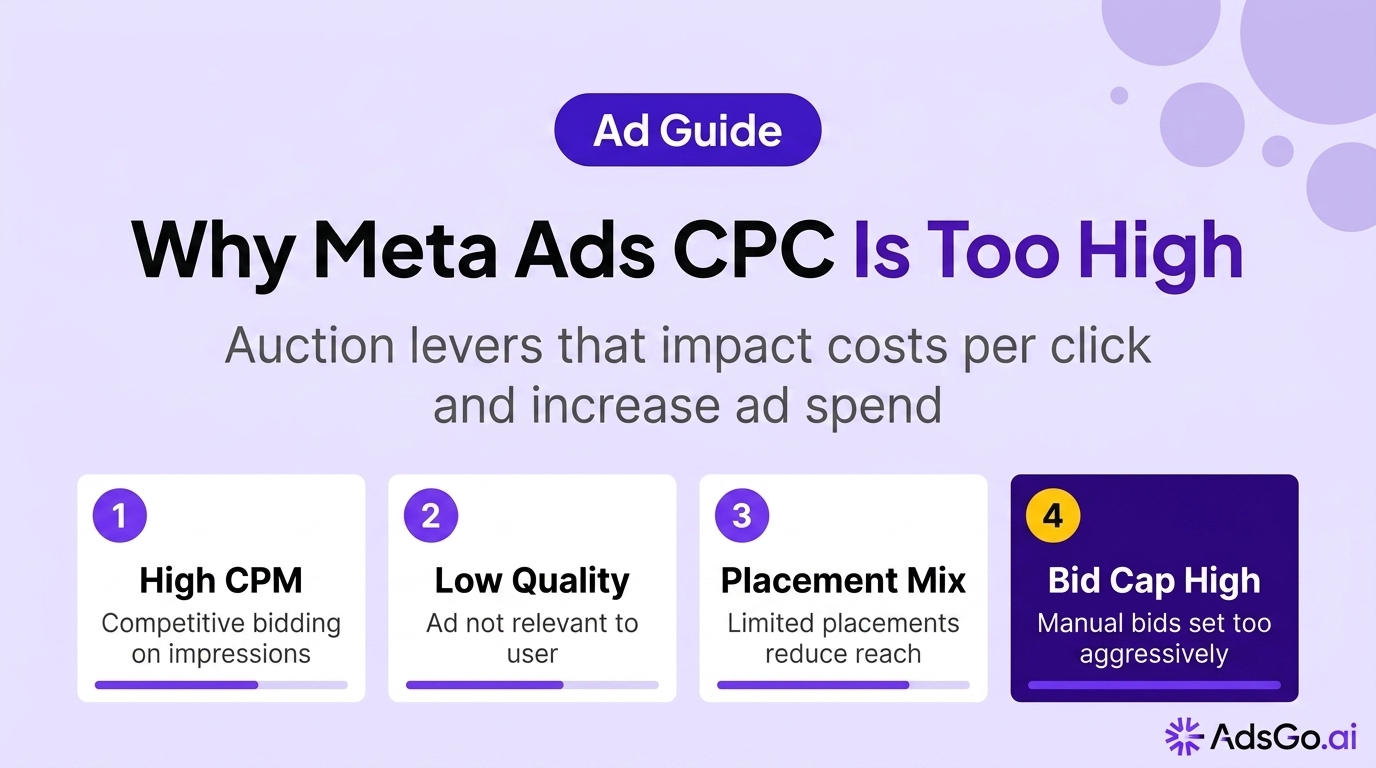
Every time someone scrolls past an ad slot, Facebook runs a lightning-fast auction. Thousands of advertisers compete for that one impression. But the winner isn't always the highest bidder.
Facebook uses a formula called Total Value Score to pick the winner:
Total Value Score = Your Bid × Estimated Action Rate × Ad Quality
Here's what that means in plain English:
- Your bid: the max you're willing to pay per click or conversion
- Estimated action rate: Facebook's prediction of how likely your ad is to get the result you want
- Ad quality: how relevant and engaging your ad is to the target audience
The key insight: a lower bid can still win — if your ad quality and relevance are high enough.
That's why two advertisers in the same niche pay wildly different prices. One pays $6 CPM (cost per 1,000 impressions). The other pays $18 CPM. Same platform, same audience, completely different costs.
Before and After: What Fixing the Auction Score Looks Like
Before optimization, imagine an ecommerce store running a single creative to a broad audience. Frequency hits 3.5. CTR (click-through rate) drops. Facebook's algorithm loses confidence in the ad and raises the bid needed to win each auction. CPM climbs from $10 to $17 in three weeks — same budget, 40% fewer impressions.
After fixing the creative rotation, tightening the audience, and adjusting bid strategy, the same account brings CPM back to $11 within two weeks. The total budget never changed. The auction score did.
If your costs are rising, your auction score dropped. And that almost always traces back to one of five causes.
The Real Reason Your Costs Went Up
Before you can fix rising costs, you need to know what's actually broken. Here are the five most common culprits — and how to spot each one.
1. Creative Fatigue — Your Audience Is Bored
When the same people see your ad too many times, they stop clicking. Facebook notices this and charges you more to keep showing it.
Check your frequency in Ads Manager. If it's above 2.5 and your CTR is falling, you've got creative fatigue. The fix isn't tweaking your existing ad — it's rotating in something new. Our guide on reducing Facebook ad creative fatigue covers the exact rotation schedule by budget level.
2. Audience Overlap — You're Bidding Against Yourself
If you run multiple ad sets targeting similar audiences, your own campaigns compete against each other in the same auction. You drive your own costs up.
Use Facebook's Audience Overlap tool under the Audiences tab. Any overlap above 20% is actively raising your prices. Consolidate or use exclusions to separate them.
3. Wrong Bid Strategy for Your Stage
Using a cost cap on a brand-new campaign is like putting a speed limiter on a car that's still learning to drive. New campaigns need Lowest Cost (automatic) bidding to gather data first. Switching to cost caps too early causes underdelivery — and ironically raises your effective cost per result.
4. Low Ad Quality Score
Facebook rates every ad based on user signals: clicks, hides, conversions, and complaints. Low-quality ads pay a premium in every auction. If users are hiding your ad or giving negative feedback, your quality score drops fast. You can check your Ad Relevance Diagnostics inside Ads Manager — look for Quality Ranking, Engagement Rate Ranking, and Conversion Rate Ranking columns.
5. Seasonal Competition
More advertisers run ads during Q4, Black Friday, and major holidays. More competition means higher auction prices — even if you didn't change anything. This is expected. The fix is to prepare ahead: build warm audiences and test creative before the rush, not during it.
Ready to Launch Smarter Campaigns?
5 Levers to Cut Your Facebook Ads Cost
These five changes have the most direct impact on your CPM and CPA (cost per acquisition). Start with the one that matches your diagnosis above.
Lever 1: Fix Your Creative (And Keep It Fresh)
Fresh creative is the fastest way to lower costs. When CTR drops and frequency rises, don't just tweak an existing ad — replace it. Plan to rotate new creative every 3–4 weeks at minimum.
Run 3–5 ads per ad set at all times. This gives Facebook enough options to optimize delivery and slows down frequency. Include at least one short-form video (6–15 seconds) — it consistently outperforms static images on conversion rate.
Lever 2: Tighten Your Audiences (Run an Overlap Audit)
Go to Facebook Audiences → select two ad sets → Actions → Show Audience Overlap. Anything above 20% means you're competing with yourself.
Consolidate overlapping ad sets, or add exclusions to separate them. Also try upgrading your Lookalike source — swap "all website visitors" for "top 25% customers by lifetime value." Better seeds produce cheaper, better-converting audiences. Our guide on finding your target audience for Facebook Ads walks through the full setup.
Lever 3: Match Bid Strategy to Your Campaign Stage
Here's a simple rule of thumb for bid strategy:
| Campaign Stage | Best Bid Strategy |
|---|---|
| New — under 50 conversions/week | Lowest Cost (automatic) |
| Growing — 50+ conversions/week | Cost Cap |
| Mature and stable | Bid Cap or Target ROAS |
| Retargeting | Lowest Cost |
Never set cost caps tighter than 10–20% above your actual target CPA. Too tight, and your ad stops delivering. Also: never change bid strategy during the learning phase. Every change resets it and temporarily spikes your costs.
Lever 4: Use Placement CPM Differences to Your Advantage
Not all placements cost the same. Here's what Q1 2026 data shows across the Meta network:
| Placement | Avg. CPM |
|---|---|
| Facebook News Feed | $16.50 |
| Instagram Feed | $14.80 |
| Instagram Stories | $9.20 |
| Instagram Reels | $7.80 |
| Facebook Marketplace | $6.50 |
| Audience Network | $3.80 |
(based on AdsGo internal campaign data)
Start with Advantage+ Placements (automatic). After 7–14 days, check the placement breakdown in your reports. If a placement has CPA more than 50% above average with minimal conversions, exclude it manually.
One important note: create placement-specific creative. A 9:16 vertical video made for Reels will outperform a feed ad auto-cropped into that format every time.
Lever 5: Move Budget to What's Actually Working
Most advertisers set campaign budgets once and barely revisit them. That means money sits in underperforming campaigns while the efficient ones are underfunded.
Check the marginal CPA (the cost of your most recent conversions) across campaigns. When it climbs above your target, that campaign has hit its ceiling. Shift budget toward campaigns that are still running efficiently.
AdsGo's Budget Allocation tool handles this automatically — monitoring marginal CPA in real time and shifting spend before costs become a problem.
Before & After: How One Account Cut CPA by 34%
Here's a real scenario from an ecommerce account optimized through AdsGo.
The problem: CPA had climbed from $28 to $47 over six weeks. The account manager kept pushing more budget, which made things worse.
What we found: Three ad sets had over 40% audience overlap. Frequency was at 3.8 on the main prospecting campaign. And they were running a cost cap of $30 on a campaign with only 20 weekly conversions — not nearly enough data for caps to work properly.
What changed:
- Consolidated the three overlapping ad sets into one
- Rotated in four new creatives and brought frequency back under 2.0
- Switched to Lowest Cost bidding until conversions hit 50+/week
- Moved 20% of budget from the saturated prospecting campaign to a warm retargeting set running at $18 CPA
The result: CPA dropped from $47 to $31 in 18 days — a 34% improvement with no increase in total budget. The only things that changed were structure, creative freshness, and bid strategy.
That's what real cost optimization looks like. Not magic — just fixing the right things in the right order.
If you want the algorithm working for you instead of against you, AdsGo's AI Optimization engine monitors creative fatigue, audience overlap, and bid efficiency automatically — and surfaces problems before they cost you.
Facebook ad costs rising with no clear fix? AdsGo diagnoses the exact cost driver and optimizes automatically. → Try AdsGo free
FAQ
My Facebook ad costs suddenly jumped — what happened?
The most common causes are creative fatigue (frequency above 2.5), audience saturation, or a seasonal spike in competition. Check your frequency and CTR trends first. If frequency is high and CTR is falling, rotate in fresh creative. If performance metrics look stable, check whether a major sale event or holiday just started driving up competition.
Is a $1.25 CPC good for Facebook ads?
It depends on your industry and what happens after the click. A $1.25 CPC with a 3% conversion rate means a $41 CPA (cost per acquisition). That might be excellent for a $150 product — and terrible for a $20 one. Always evaluate CPC in the context of your conversion rate and product margin.
Will increasing my budget lower my Facebook ad costs?
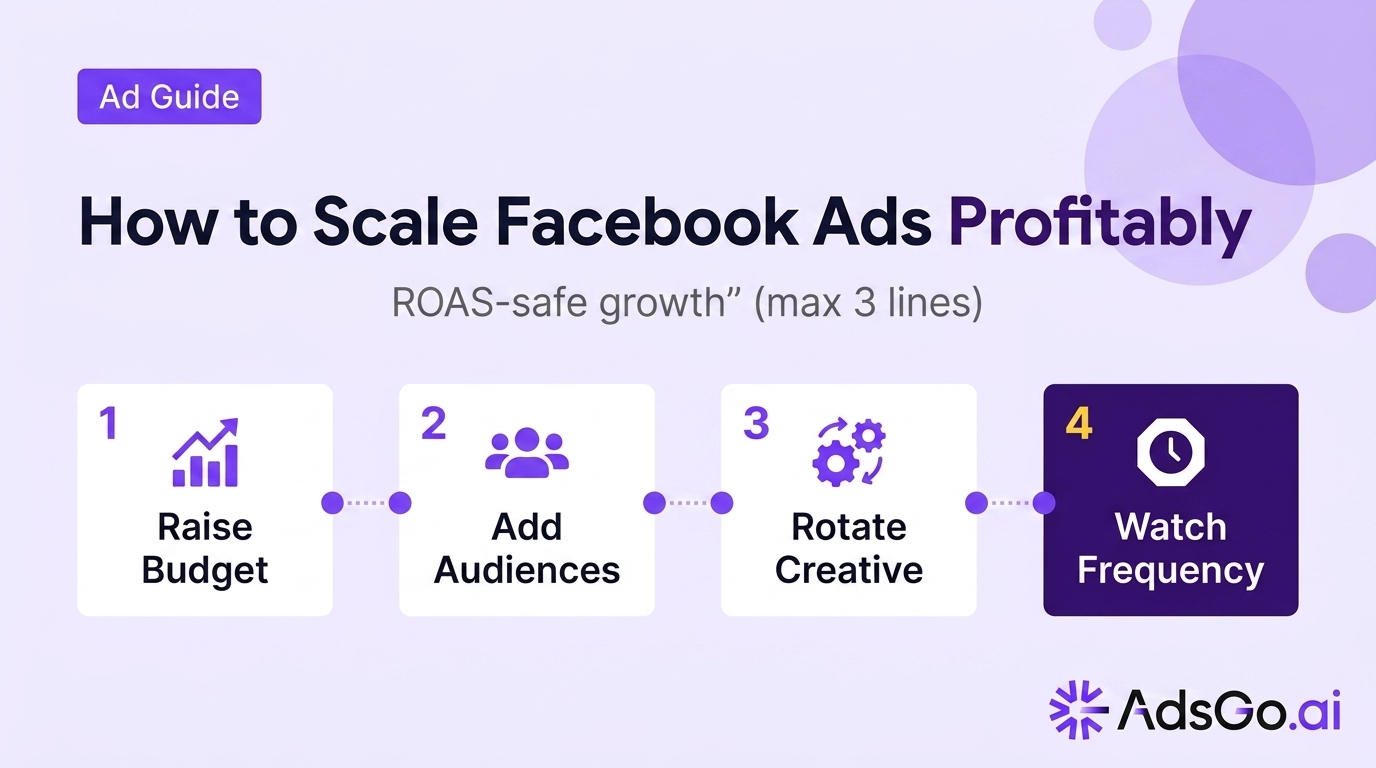
Usually the opposite happens, at least short-term. Budget increases above 20% reset Facebook's learning phase and cause cost spikes for 3–7 days. Scale gradually: increase by 15–20% every 3–4 days and watch your marginal CPA closely.
Do Advantage+ campaigns actually save money?
For ecommerce brands with solid pixel data, often yes. Advantage+ Shopping Campaigns reduce audience fragmentation, which can lower both CPM and CPA. But they give you less control. Run them alongside your standard campaigns for at least 14 days before shifting major budget over.
How do I know if my ad quality score is hurting me?
In Ads Manager, go to Columns → Customize Columns → add "Quality Ranking," "Engagement Rate Ranking," and "Conversion Rate Ranking." If any show "Below Average," that ranking is directly raising your auction costs. Fix or replace that ad.
Can AI tools actually reduce ad costs, or is that just marketing?
The mechanism is real. AI reduces costs by doing things faster than humans can: reallocating budget before CPA spikes, catching creative fatigue early, and flagging audience overlap before it compounds. In AdsGo's internal analysis across 200 accounts, AI-managed campaigns averaged 22% lower CPM and 27% lower CPA compared to manually managed ones. (based on AdsGo internal campaign data)