
Every advertiser who has tried to scale Facebook ads has experienced the same frustrating pattern: double the budget, ROAS drops by 40%. Cut budget back to the original, ROAS recovers. Double budget again — same result.
This isn't a Meta bug. It's the predictable consequence of scaling in the wrong direction, at the wrong pace, with the wrong infrastructure. Most scaling failures come down to one of three mistakes: scaling too fast, scaling without fresh creative, or confusing vertical scaling with horizontal scaling.
Why Most Scaling Attempts Fail
The ROAS decline when scaling budget is not random. It follows a predictable mechanism:
When you increase budget, Meta must spend more money within the same delivery window. To do this, the algorithm reaches further into your audience — serving ads to users who are less similar to your high-intent converters. These marginal users have lower purchase intent, which drives down CVR and, with it, ROAS.
The second pressure point: higher budget means faster frequency accumulation on your core audience. If your winning audience is 500K people and you go from $100/day to $500/day, your frequency on that audience increases 5× faster. Creative fatigue arrives 5× sooner.
Understanding these two mechanisms explains why every scaling strategy is a combination of audience expansion (addressing mechanism 1) and creative velocity (addressing mechanism 2).
Vertical Scaling vs. Horizontal Scaling
Vertical Scaling: Increasing Budget on Existing Campaigns
Vertical scaling means raising the daily budget on campaigns that are currently performing. This is the simplest form of scaling — one change, immediate effect.
When it works: The campaign has been stable for 14+ days, ROAS has been consistent within 15% week-over-week, audience frequency is below 2.0, and you have at least 3–5 fresh creative variants ready to rotate when fatigue appears.
When it fails: The campaign is in or near learning phase, audience frequency is already above 2.5, or you're in a high-competition seasonal period (Q4, major shopping events) where additional budget drives CPM higher faster than it drives revenue.
Safe scaling threshold: Increase budget by no more than 20–30% per 3— days. Budget increases above 30% in a single edit reset the learning phase for CBO campaigns and trigger a new delivery pattern exploration period that temporarily depresses ROAS.
The 20–30% rule: if your campaign has a $100/day budget and is performing at 3.5× ROAS, increase to $120–130/day. Wait 5 days. If ROAS remains above your break-even, increase again. This compounding approach typically scales budgets 3–4× over 30 days without triggering the full ROAS crash that comes from sudden doubling.
Horizontal Scaling: Duplicating Campaigns With New Audiences
Horizontal scaling means creating new campaigns or ad sets targeting audiences that haven't been reached, rather than spending more on the audiences already being reached. This approach avoids frequency acceleration but requires more creative and audience research.
When to use horizontal scaling: When your primary campaign has achieved frequency above 2.5, when vertical scaling has stalled (ROAS drops with each budget increase), or when you want to test substantially different audience types (Interest vs. Lookalike vs. Broad).
Common horizontal scaling paths:
- Duplicate the winning ad set and change to a Lookalike 3–5% (vs. 1% original)
- Create a new ad set targeting a complementary Interest audience that doesn't overlap with existing targeting
- Create a new ad set targeting a different geographic market
The creative problem with horizontal scaling: New audiences require fresh creative. The exact ad that resonates with your current Lookalike 1% audience may not resonate with a Lookalike 4% — the behavioral overlap decreases as the audience broadens. Budget horizontal scaling with creative testing funds, not just media spend.
Scaling Failure Reasons: The 4 ROAS Killers
ROAS Killer 1: Scaling Into Creative Fatigue
The most common scaling failure. You scale budget on a campaign with frequency 2.8 and CTR already declining 10% from its peak. Higher budget accelerates frequency further, CTR drops to 0.6%, CPM rises (quality penalty kicks in), and ROAS collapses within 72 hours.
Prevention: Never scale budget without checking frequency. If frequency is above 2.0, launch at least 2 new creative variants before increasing budget. Scale the new creative alongside the budget increase.
ROAS Killer 2: Scaling During High-Competition Windows
Q4, major holiday sales periods, and competing brand launches create CPM spikes that reduce ROAS for any given budget level. Scaling budget into a 40% CPM spike means you're paying 40% more for the same impressions — a direct ROAS reduction before any campaign variable changes.
Prevention: Monitor CPM trend in your Ads Manager. If CPM has increased more than 20% in the past 7 days without audience changes, wait for the competitive pressure to normalize before vertical scaling.
ROAS Killer 3: Learning Phase Reset From Aggressive Scaling
Budget increases above 30–40% on a CBO campaign reset the campaign's delivery optimization to a new learning state. During this reset, the algorithm explores new delivery patterns — often finding less efficient patterns temporarily — causing a ROAS dip that can last 7–10 days.
Prevention: Scale in increments of 20–30% maximum. For campaigns where learning reset would be particularly costly (high-volume, highly optimized campaigns), consider duplicating the campaign at the new budget level rather than editing the existing campaign.
ROAS Killer 4: Over-Concentration in One Audience
Scaling a single ad set with a single audience means all additional budget goes to the same pool of users — accelerating saturation. A campaign that scaled from $200/day to $1,000/day using only one Lookalike 1% audience (typically 500K–1M people) will fully saturate that audience within 30–40 days at high budget.
Prevention: Build a campaign architecture that supports scaling before you start scaling. Multiple audiences in a CBO campaign allow Meta to distribute larger budgets across non-overlapping user segments.
Ready to Launch Smarter Campaigns?
Safe Scaling Thresholds
These thresholds apply to Facebook/Instagram prospecting campaigns with purchase optimization:
| Campaign Stage | Safe Weekly Budget Increase | Key Condition |
|---|---|---|
| Week 1–2 (Learning) | Do not scale | Let learning complete |
| Week 3–4 (Early stable) | 15–20% per 5 days | ROAS within 15% of target |
| Month 2+ (Stable) | 20–30% per 5 days | Frequency below 2.5 |
| Aggressive scaling | 30% maximum, with new creative | 50+ weekly conversions, 3+ fresh creatives ready |
At any point where ROAS drops more than 25% from baseline after a budget increase, reduce budget to the previous level immediately. Do not layer additional changes on top of a declining performance signal — diagnose first.
The ROAS Stability System
Sustainable scaling requires a system that maintains ROAS performance as budget grows, rather than relying on manual monitoring to catch problems after they've already damaged results.
Three Pillars of ROAS Stability at Scale
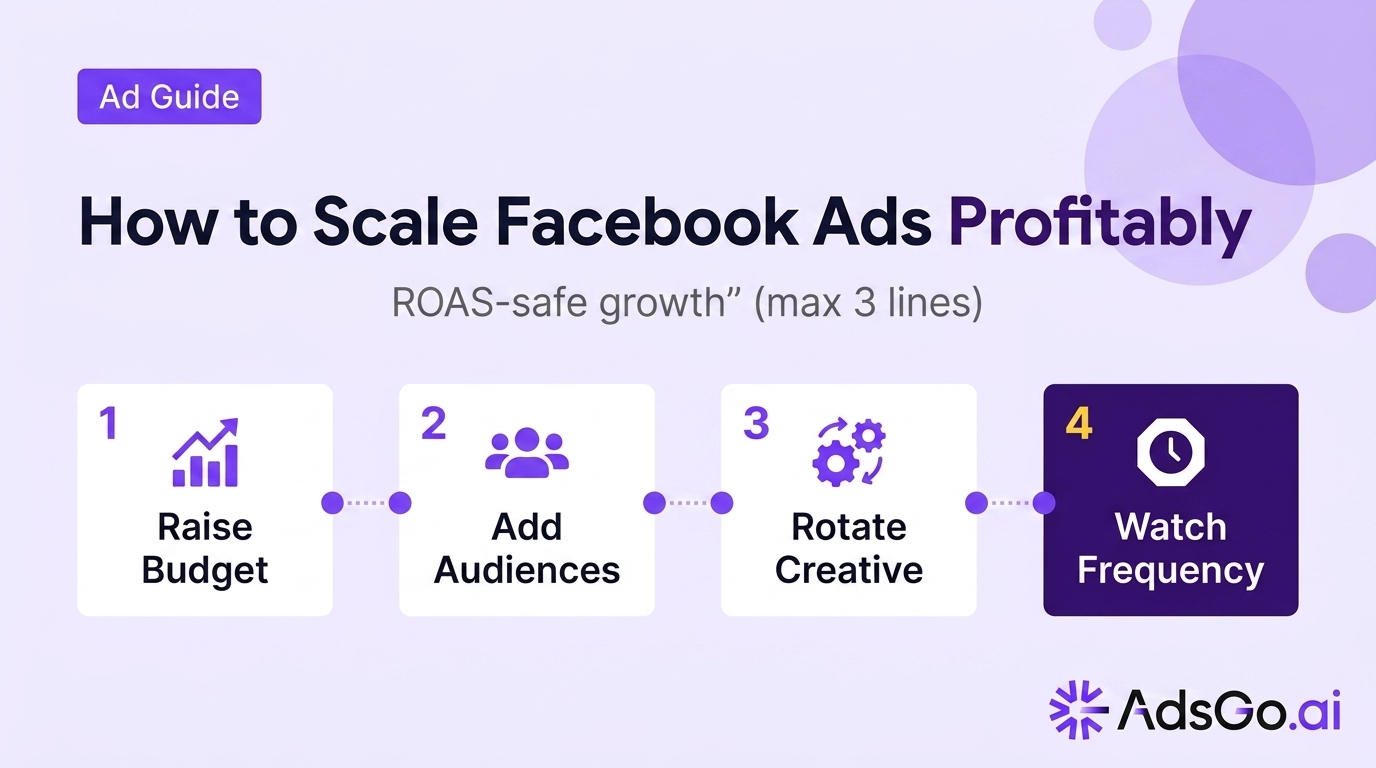
Pillar 1: Creative Rotation System Maintain a queue of at least 4–6 tested creative variants per campaign. When a creative's CTR drops 20% from its peak (an early fatigue signal), rotate in the next variant from the queue before pausing the declining one. Never let a campaign reach near-zero CTR before replacing creative.
Pillar 2: Audience Expansion Pipeline Before scaling budget significantly, validate that you have additional audience layers ready to activate. A Lookalike 1–3% as the primary, Interest-based audiences as secondary, and Broad targeting as a third tier. When one audience saturates, the next tier is already tested and ready for budget.
Pillar 3: ROAS Monitoring Cadence During active scaling, check ROAS daily for the first 2 weeks after each budget increase. After stability is confirmed, shift to 3× weekly monitoring. ROAS problems that aren't caught within 48 hours of onset can compound over 7+ days of wasted spend at the new, higher budget level.
Scaling Facebook ads but ROAS is dropping? AdsGo maintains ROAS stability as you increase spend. → Try AdsGo free
How AdsGo Manages Scaling Operations
Scaling operations — monitoring frequency, timing creative rotations, tracking CPM trends, staging audience expansions — require significant operational bandwidth. For accounts scaling from $5K/month to $30K/month, manual management becomes the bottleneck.
AdsGo's budget allocation system automates budget scaling operations: monitoring ROAS trends in real time, applying safe incremental increases when performance is stable, and pausing increases (or reducing budget) when performance signals indicate a scale-triggered regression.
AdsGo's AI optimization triggers creative rotation when frequency thresholds are approaching, before CTR decline begins. This proactive rotation is the single most important factor in maintaining ROAS stability during aggressive scaling, and it's the operation most commonly missed in manual management workflows. (based on AdsGo internal campaign data)
FAQ
How much should I increase my Facebook ads budget to scale?
Increase by 20–30% every 5 days on stable, well-performing campaigns. This is the maximum increment that avoids triggering a learning phase reset on CBO campaigns. If you need to scale faster, duplicate the campaign at the new budget level rather than editing the existing one — this preserves the original campaign's optimized delivery while testing whether the higher budget performs.
Why does ROAS drop when I scale Facebook ads?
ROAS drops when scaling because the algorithm must reach lower-intent users to spend the larger budget (diluting CVR) and because higher budget accelerates frequency on your core audience (triggering creative fatigue faster). Both effects are predictable and manageable through horizontal scaling, creative rotation, and incremental budget increases.
Should I use CBO or ABO when scaling?
CBO for most scaling scenarios above $200/day — it allows Meta's algorithm to dynamically allocate across audiences as performance signals change, which is essential when scaling into saturation conditions. ABO when you need guaranteed spend on specific ad sets that CBO would otherwise starve, or when testing new audiences that need protected budget to gather data.
When is it safe to double my Facebook ads budget?
It's rarely safe to double budget in a single edit. The 30% threshold for avoiding learning phase resets makes a true doubling an aggressive move that typically triggers 5–10 days of elevated CPA/lower ROAS while the algorithm re-optimizes. If you need to double budget quickly, do it in 2 steps of 40–50% each with a 5-day gap, or duplicate the campaign at the new budget level.
How long does it take for a scaled campaign to stabilize?
After a significant budget increase (30%+), expect 7–14 days before performance stabilizes. The algorithm explores new delivery patterns during this period. Evaluating the success of a scale within the first 3 days will produce misleading data — early instability is normal and doesn't indicate that the scale will fail long-term.