
A high CPC isn't just a cost problem — it's diagnostic information. Every dollar above your target CPC tells you something specific about what's failing in your campaign: your creative quality, your bid strategy, your audience choice, or your placement mix. The fix requires identifying which one.
Most guides recommend "lower your bid" or "expand your audience" without explaining the mechanism. This guide works through the auction math first, so every recommendation is grounded in how Meta actually prices clicks.
CPC Is the Result of an Auction, Not a Fixed Price
CPC = CPM ÷ (CTR × 1000)
This formula is the foundation of everything. Your cost per click is not a number you set — it's the output of two variables you can influence: how much you pay per 1,000 impressions (CPM) and how many of those impressions generate clicks (CTR).
Lowering CPC requires either lowering CPM or increasing CTR — or both simultaneously.
The Auction Formula: What Meta Actually Measures
Meta's auction doesn't bid on a per-click basis. It bids on impressions (CPM) through a second-price auction where the winner pays just enough to beat the next-highest bidder. Your effective bid in this auction is:
Effective Bid = Your Bid × Estimated Action Rate × Ad Quality Score
This means a low-quality ad with a high nominal bid can lose to a high-quality ad with a lower bid, because Meta is selling attention at the impression level and rewarding ads that users engage with.
The practical implication: improving your creative quality (which raises your Ad Quality Score and Estimated Action Rate) reduces the effective CPM you pay, which reduces CPC — without changing your bid cap at all.
The CPM–CTR–CVR Relationship
Understanding how these three metrics interact explains most high-CPC scenarios:
CPM (cost per 1,000 impressions) is determined primarily by audience competition, time of day, placement, and your quality score. A high CPM means you're paying a premium to reach your audience.
CTR (click-through rate) is the percentage of impressions that generate clicks. A high CTR means your ad is resonant with the audience it's reaching — users are choosing to click. In the auction formula, high CTR effectively lowers your CPC because you're getting more clicks per CPM dollar.
CVR (conversion rate) doesn't directly affect CPC, but it affects your Estimated Action Rate — Meta's prediction of whether a user will complete your objective. If historical CVR from similar ads is low, Meta predicts low action rates and reduces your effective bid in the auction, causing you to lose more auctions and (counterintuitively) sometimes pay more per click on the auctions you do win.
The relationship: CPC = CPM ÷ (CTR × 1000). If your CPM is $12 and CTR is 1.0%, CPC = $1.20. If CPM stays at $12 but CTR rises to 2.0%, CPC drops to $0.60 — a 50% reduction without touching your bid.
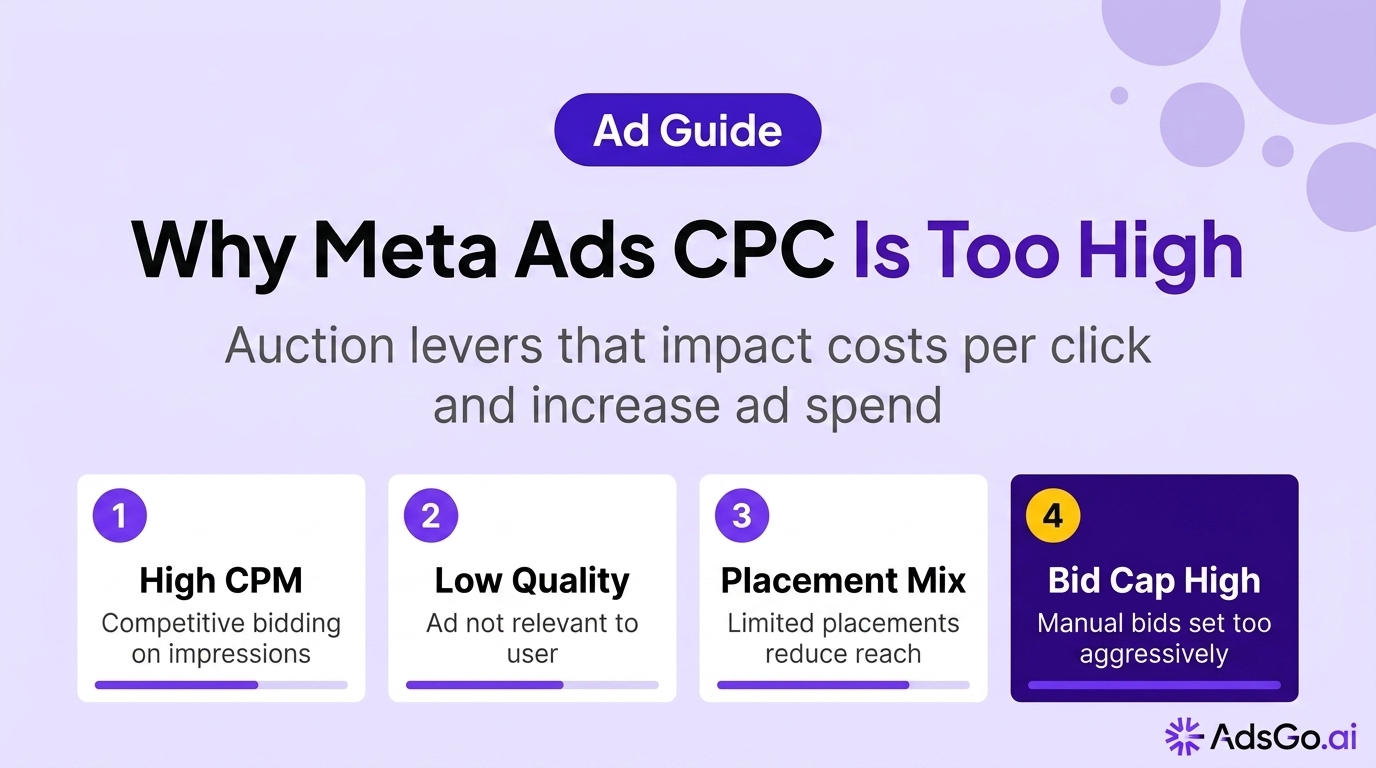
The 4 Mechanisms Behind High CPC
Mechanism 1: Audience Over-Competition
When multiple advertisers compete for the same audience simultaneously, CPM rises. High-competition audiences are those defined by narrow Interest targeting, small custom audience retargeting, or high-income demographic segments that advertisers pay a premium to reach.
The holiday season (Q4) raises CPM across all audiences by 30–40% compared to Q1 (industry estimate). If your CPC is spiking seasonally, it's not a campaign problem — it's a market condition.
Indicators: Your CPM has increased without changes to your targeting or bid strategy. Audience size is under 500K. You're in a high-competition vertical (finance, insurance, luxury goods).
Mechanism 2: Low Creative Quality Score
An ad with low quality — either from user "Hide Ad" feedback, low relevance to the audience, or sensationalist/misleading content — receives a quality penalty in the auction formula. This penalty reduces your effective bid, causing you to lose more auctions and pay higher CPM on the auctions you win (because you need to outbid more competitors to secure delivery).
Indicators: Your ad relevance diagnostics show "Below Average" for Quality Ranking. You've seen increasing numbers of comments indicating irrelevance or negative feedback. CTR is declining even though you haven't changed your audience.
Mechanism 3: Placement Mix Skewed Toward Premium Inventory
Not all placements are equal in price. Facebook Feed and Instagram Feed are premium placements with higher CPMs. Audience Network and Facebook Marketplace are lower-CPM placements. If your placement is set to manual and restricted to high-CPM placements, your blended CPC will be higher than accounts running on Advantage+ Placements (which automatically shifts budget toward more efficient inventory).
Indicators: You're running manual placements on Facebook/Instagram Feed only. Your CPM is above $15 with a broad audience, suggesting premium placement mix.
Mechanism 4: Bid Cap Set Too High Relative to Market
A bid cap set significantly above the auction clearing price doesn't just cost you more — it can cause you to overpay for inventory that you could have won at a lower price. While Meta's second-price auction theoretically prevents overpaying, bid caps set at extreme levels (e.g., $50 CPC cap in a $1.50 CPC market) can signal to the algorithm to prioritize expensive, high-quality placement slots over efficient ones.
Indicators: Your bid cap is set manually at a price significantly above your historical CPC. Switching to Lowest Cost bidding (no cap) results in lower actual CPC.
Ready to Launch Smarter Campaigns?
Fixing High CPC: 4 Structural Approaches
Fix 1: Improve CTR to Exploit the Auction Formula
The fastest and most sustainable CPC reduction comes from improving CTR. As the formula shows, doubling CTR halves CPC with the same CPM. Focus on the hook (first 3 seconds of video, first frame of image), headline relevance to the audience, and visual differentiation from the editorial content around your ad.
A/B test hooks specifically: problem-statement hooks vs. curiosity-gap hooks vs. social proof hooks. In our analysis of 500+ Meta campaigns at AdsGo, social proof hooks (specific numbers, verified results) consistently outperform generic benefit statements by 40–50% on CTR. (based on AdsGo internal campaign data)
Fix 2: Expand Audience to Reduce Competition Density
Narrow interest targeting increases the concentration of competing advertisers reaching the same small pool of users, driving up CPM. Widening your audience to 1M–2M distributes your spend across less contested user segments, reducing CPM and therefore CPC.
Practical expansion options: add 1–2 additional interest categories, remove one layer of demographic narrowing, or switch from Interest to Lookalike 3–5% (which tends to reach a broader, less competed-for audience than narrow Interest stacks).
Fix 3: Switch to Advantage+ Placements
Meta's Advantage+ Placements automatically allocates your budget toward placements with the lowest effective CPM for your audience. Studies consistently show that Advantage+ Placements reduces CPM by 10–20% compared to manual placement selection restricted to premium inventory. (Source: Meta Business, 2025) The blended CTR may be lower (Audience Network has structurally lower CTR), but the CPM reduction typically produces net CPC improvement.
Fix 4: Remove Bid Cap During High-CPC Periods
Counterintuitively, removing your bid cap during high-competition periods (Q4, major holidays) often produces lower CPC than maintaining a cap. With no cap, Meta's Lowest Cost algorithm optimizes for efficient impressions across the full available inventory. A bid cap set below the clearing price causes you to lose most auctions and concentrate spend on the most expensive remaining inventory you can win.
Remove the cap, run Lowest Cost for 72 hours, and compare the actual CPC to your capped baseline.
Meta ads CPC rising with no clear cause? AdsGo identifies your auction inefficiencies and corrects them. → Try AdsGo free
How AdsGo Optimizes Bidding Automatically
Bid management is a continuous process. Auction clearing prices change by hour, by day of week, and with competitive activity. Manual bid adjustments can't keep pace with these fluctuations.
AdsGo's AI optimization system monitors CPM, CTR, and CPC in real time across all Meta campaigns. When CPC trends above your target threshold, AdsGo identifies which mechanism is driving the increase — audience competition, quality penalty, or placement mix — and applies the appropriate adjustment automatically.
For accounts with AdsGo's budget allocation enabled, the system dynamically shifts budget toward ad sets with lower CPC during high-competition periods, maintaining overall efficiency even as individual auction prices fluctuate. (based on AdsGo internal campaign data)
FAQ
What is a good CPC for Facebook ads in 2026?
Average Facebook CPC across industries is $0.94 (Source: WordStream, 2025). By industry: ecommerce $0.70–1.20, retail $0.60—.10, SaaS $1.50–2.50, finance $2.50–3.00, B2B services $2.00–2.50. Compare against your industry benchmark, not the overall average.
Why did my Facebook ads CPC suddenly double overnight?
Sudden CPC spikes are usually caused by a competitor entering your auction with a higher bid, a seasonal CPM increase (major holidays, shopping events), or Meta's algorithm detecting declining ad quality signals and increasing your effective CPM. Check your Audience Overlap report and CPM trend to identify which factor is responsible.
Does Lookalike audience targeting cost more than Interest targeting?
Not necessarily. Lookalike audiences (1 — %) often produce lower CPC than narrow Interest stacks because they're less competed-for by other advertisers, and they tend to have higher action rates (since they resemble your actual customers). The CPM may be similar or slightly higher, but the CTR improvement typically produces better CPC.
Should I use manual bids or automatic bids to lower CPC?
For most campaigns, Lowest Cost (automatic) bidding produces lower effective CPC than manual bid caps, because it optimizes across all available auction slots rather than concentrating spend on inventory within your cap. Use manual bid caps only when you have a hard CPC constraint you cannot exceed, and set the cap at 2–3× your target CPC to allow room for the algorithm to operate.
Can improving my landing page lower my Facebook CPC?
Indirectly, yes. Better landing pages improve conversion rates, which improves Meta's Estimated Action Rate for your ads, which improves your effective bid in the auction formula, which allows you to win more auctions at lower prices. The effect isn't immediate — it takes 7–14 days for Meta's algorithm to incorporate improved conversion data into its action rate prediction — but it is real.